Scent Branding: Build a Signature Brand Fragrance
Last Updated: July 2026
Scent branding is one of the most underused yet scientifically validated strategies available to business owners right now. When a carefully developed signature fragrance is deployed consistently across your brand environment, it directly influences how long customers stay, how strongly they recall your brand, and how emotionally connected they feel to your business. Studies show scented environments generate dwell time increases of 15–40%, consumer scent recall rates that beat visual memory by more than a year, and sales lifts of up to 33% in documented retail cases. This guide breaks down how scent branding works, what the research shows, and exactly how to build a signature brand scent from scratch.
Key Takeaways
- Scent is the only sense with a direct neurological connection to the brain’s emotional and memory centers, making it powerfully effective for brand recall.
- A signature scent functions as an olfactory logo—a recognizable sensory asset that builds brand equity over time.
- Scented retail environments see measurable increases in dwell time, sales conversion, and customer satisfaction scores.
- The fragrance family you choose (fresh, floral, woody, amber) should map directly to your brand personality and target audience.
- Consistency across all physical touchpoints is what separates scent branding from generic air freshening.
- Businesses of all sizes—from boutique retailers to nonprofits—can build a scent branding program with the right professional partner.
Scent Branding vs. Scent Marketing: Understanding the Difference

These two terms get used interchangeably, but they describe different things. Getting clear on the distinction helps you make smarter strategic decisions from the start.
Scent marketing is the broader practice of using fragrance intentionally within a business environment to shape customer behavior, manage atmosphere, and improve the overall experience. It includes everything from diffusing calming lavender in a healthcare waiting room to pumping energizing citrus through a gym. Scent marketing is situational — it targets how a customer feels in a specific moment or space.
Scent branding is more specific and more strategic. It involves developing a signature scent — a proprietary fragrance tied exclusively to your brand identity — and deploying it consistently across every customer touchpoint. The signature scent becomes what industry professionals call an olfactory logo: as distinctive and ownable as your visual logo, but communicating through the sense of smell rather than sight.
The simplest way to think about it: ambient scenting improves an atmosphere. Scent branding builds a brand asset.
A luxury hotel might use calming ambient scenting in its spa and energizing scents in its fitness center. But that same hotel also diffuses its signature fragrance in every lobby, hallway, and guest room across all its properties worldwide — so that returning guests feel an immediate sense of familiarity before they see a single piece of décor. That signature-scent consistency is scent branding.
Many successful brands run both strategies simultaneously, layering ambient scenting choices on top of a consistent olfactory identity.
The Neuroscience Behind Why Scent Branding Works

Of all five senses, smell is the only one with a direct neural connection to the limbic system — the region of the brain responsible for emotion, memory formation, and motivation. Every other sense routes through the thalamus first. Scent bypasses that relay entirely, creating an immediate, unfiltered emotional response.
The practical implications of this neurological shortcut are significant:
- Humans can recognize approximately 10,000 different odors.
- People recall scents with 65% accuracy after a full year, compared to only 50% accuracy for visual memories after just three months (Sense of Smell Institute). Scent memory dramatically outlasts visual memory.
- Scent is believed to influence approximately 75% of daily emotions, making it the most emotionally impactful of all the senses.
- The global scent marketing market was valued at over $3.1 billion in 2025 and is projected to grow at a compound annual growth rate exceeding 8% through 2030, driven by accelerating adoption across retail, hospitality, and healthcare (Grand View Research, 2025).
- Audio branding recall rates average around 20% in short-term studies, while visual logo recognition fades sharply after 72 hours. Scent-linked memories, by contrast, remain intact for months — sometimes years.
When a brand consistently pairs a specific fragrance with a positive customer experience, the brain encodes that association in long-term memory. Eventually, the scent alone can trigger the emotional response — trust, warmth, excitement — before any visual or verbal brand cue even registers. That is the foundation of the emotional loyalty that scent branding builds.
How to Create a Signature Brand Scent: A Step-by-Step Framework
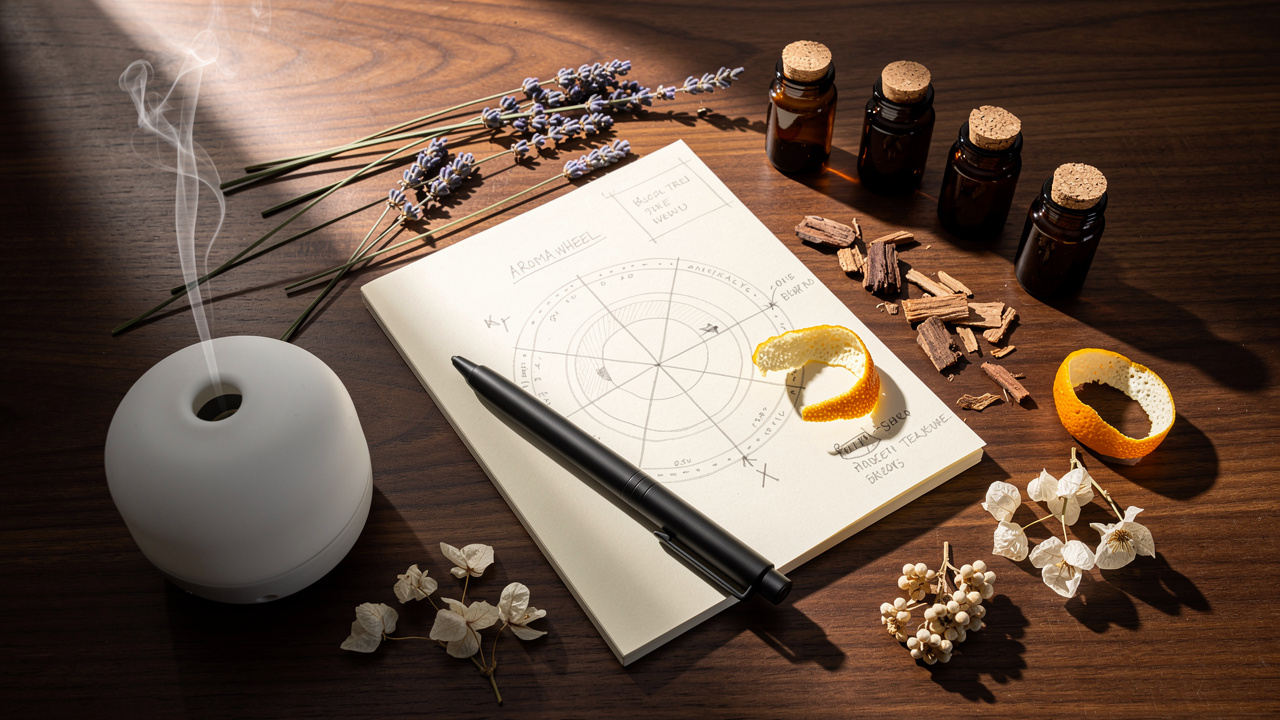

Building a signature scent is not about picking something that smells nice. It is a strategic process that starts with your brand identity and ends with a proprietary fragrance that is ownable, recognizable, and emotionally resonant. Here is how to approach it.
Step 1: Define Your Brand Identity and Goals
Before you select a single fragrance note, get specific about what your brand stands for. Ask:
- What are your core values?
- What emotional experience do you want a customer to associate with you?
- Who is your target customer, and what sensory signals will feel authentic to them?
- What measurable outcomes are you targeting — increased dwell time, higher satisfaction scores, stronger repeat visit rates?
These answers form the creative brief that guides every fragrance decision that follows.
Step 2: Map Your Brand to a Fragrance Family
Fragrance families are the broad olfactory categories that organize scents by their dominant character. Each family communicates a distinct brand personality and evokes different emotional responses. Selecting the right family is the most consequential decision in the scent development process.
| Fragrance Family | Brand Personality It Communicates | Examples in Practice |
|---|---|---|
| Fresh / Citrus | Energy, approachability, cleanliness, vitality | Fitness brands, tech retailers, health-focused food concepts |
| Floral | Femininity, romance, natural beauty, luxury | Boutique fashion, beauty retail, lifestyle brands |
| Woody / Earthy | Heritage, craftsmanship, groundedness, sophistication | Luxury goods, automotive, heritage footwear, financial services |
| Warm / Amber | Comfort, indulgence, intimacy, sophistication | Hotels, spas, premium hospitality, fine dining |
| Herbal / Green | Wellness, calm, nature, mindfulness | Spas, wellness brands, natural product retailers |
Practical brand-to-fragrance mapping:
- A fitness brand focused on performance and vitality → clean citrus-forward scent that signals momentum and energy
- A luxury heritage brand like a fine watchmaker or premium leather goods retailer → warm woody and leather notes that evoke craftsmanship and longevity
- A wellness spa → herbal and botanical notes that promote calm and restoration
- A boutique hotel targeting affluent travelers → warm amber and musky notes that communicate comfort and exclusivity
- A modern tech retailer → fresh, clean, slightly mineral scent that feels forward-thinking and precise
Step 3: Identify Your Customer Touchpoints
Map every physical environment where customers interact with your brand. Entrances and reception areas create first impressions. Fitting rooms, showrooms, and anywhere a purchasing decision is made are high-stakes scenting zones. For multi-location businesses, every location is a touchpoint that needs the same fragrance at the same intensity.
Step 4: Work with a Professional Scent Developer
Partner with a professional scent marketing firm rather than purchasing off-the-shelf diffusers — much like how Why 40% of AI agent projects fail when businesses skip specialized expertise, scent programs underdeliver without professional guidance. Specialized partners bring expertise in fragrance chemistry, olfactory psychology, brand strategy, and commercial diffusion technology. They can navigate custom development versus ready-to-use fragrance libraries based on your budget and timeline.
Consumer-grade diffusers cannot cover large spaces consistently or deliver the calibrated scent output that effective scent branding requires. Commercial systems are built for scale, consistency, and precise intensity control — preventing the over-saturation that turns a pleasant brand signal into an overwhelming one.
Step 5: Deploy Consistently and Measure Results
Establish baseline metrics before launch: customer satisfaction scores, average transaction values, dwell time data, and repeat visit rates. After implementation, track changes systematically. Use the data to refine fragrance intensity, diffusion scheduling, and zone placement over time.
What the Data Shows: Real Business Outcomes
Scent branding’s impact is not theoretical. A growing body of independent research and real-world business data documents its measurable effect on customer behavior and revenue.
Businesses using professional scent marketing services consistently report:
- A 20% increase in customer satisfaction scores
- An 11% rise in daily retail sales
- An 8% improvement in food quality perception scores — with no changes to the actual product
- Dwell time increases of 15–40% across retail and hospitality settings, with the strongest gains occurring where the fragrance is brand-congruent rather than generic
Published case studies add further weight:
- A kitchen appliance retailer diffused the scent of freshly baked apple pie and recorded a 33% increase in sales (Lindström, M., Brand Sense, 2010).
- A German DIY retailer introduced the scent of fresh-cut grass and saw customers rate their shopping experience nearly 50% more positively. Employees were also perceived as more competent and motivated — a perception shift driven entirely by fragrance.
- New Balance, introduced to Chinese shoppers through a sensory store experience featuring a wood-and-leather scent, saw shoppers spend twice as much compared to similarly sized stores without the scent strategy.
“The longer a customer stays in a store, the more they spend.” — Retail sensory research team, New Balance China study
The mechanism behind these numbers is clear: scent changes how people perceive product quality, service quality, and staff competence — independently of any actual changes to those things. That perceptual shift translates directly into purchasing behavior.
Scent Branding by Industry: Applications and Real Brand Examples
Retail
Singapore Airlines developed a proprietary onboard fragrance called Stefan Floridian Waters, applied to flight attendants’ uniforms, hot towels, and diffused throughout the cabin. The scent has become so closely associated with the airline’s premium positioning that passengers cite it as a meaningful part of what makes the brand feel distinctive. The result: consistently strong brand recognition metrics in passenger surveys and one of the highest customer loyalty scores in commercial aviation.
Beyond airlines, boutique fashion retailers use fresh floral or warm amber fragrances in flagship stores to create environments where customers linger longer and associate the brand with a feeling they want to return to. Research from the Journal of Business Research found that scent-congruent retail environments increase purchase intent by up to 28% compared to unscented equivalents.
Hospitality
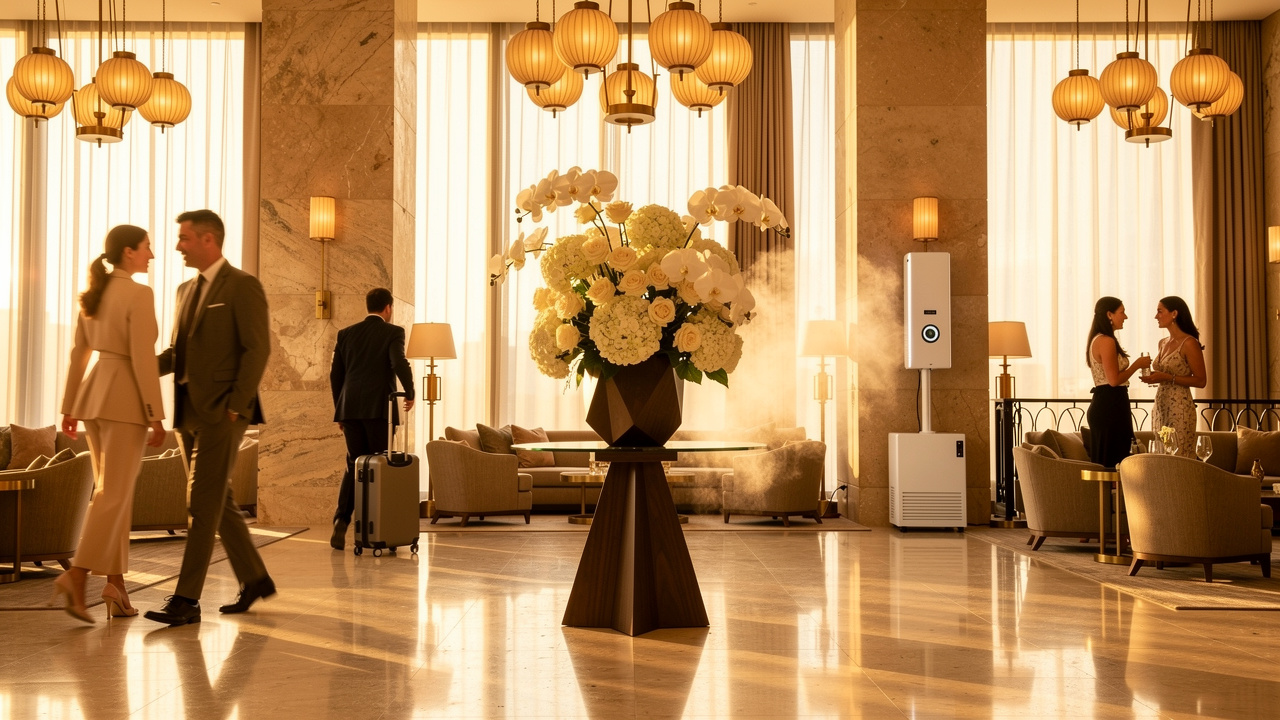
Marriott’s W Hotels chain developed a signature white tea scent deployed uniformly across its global properties. Returning guests report an immediate sense of recognition and belonging upon entering any W property worldwide — a direct outcome of consistent scent branding over time.
“Scent is the fastest way to create a sense of place. Our guests recognize a W before they even check in.” — W Hotels brand team
Hotel brands deploying signature fragrances see measurable increases in guest satisfaction scores and lower average cancellation rates compared to unscented properties. Some brands have extended their signature scents into retail products — candles, room sprays, bath amenities — converting fragrance into a direct revenue stream and a portable brand experience guests take home.
Luxury and Automotive
Rolls-Royce uses scent strategically throughout its showrooms to reinforce quality and craftsmanship perceptions. The intent is to extend the olfactory experience of a premium vehicle — leather, polished wood, clean precision — into the broader dealership environment, so the sensory impression of entering the showroom aligns with the brand promise of the vehicle itself.
For luxury goods brands, a woody and leather-forward scent signals the same heritage and quality that the product communicates — creating a fully coherent, multi-sensory brand experience. Studies on luxury retail environments suggest that scent-enhanced showrooms can increase time-on-premises by up to 26%, directly influencing high-consideration purchase decisions.
Wellness and Healthcare
Lush Cosmetics deploys a bold, distinctive fragrance strategy that functions as one of the most aggressive forms of retail scent branding in consumer goods. The intense fragrance presence in and around Lush stores is a deliberate identity signal — one that attracts the brand’s core audience and creates unmistakable brand recognition even from outside the store entrance. The approach reinforces the brand’s position as sensory, natural, and unapologetically distinct.
In healthcare, facilities using calming herbal or soft floral fragrances in waiting areas have documented reductions in patient anxiety scores of up to 30% and lower appointment cancellation rates — measurable outcomes that affect both patient experience and operational efficiency (International Journal of Environmental Research and Public Health, 2024).
Scent Branding as a Long-Term Brand Asset
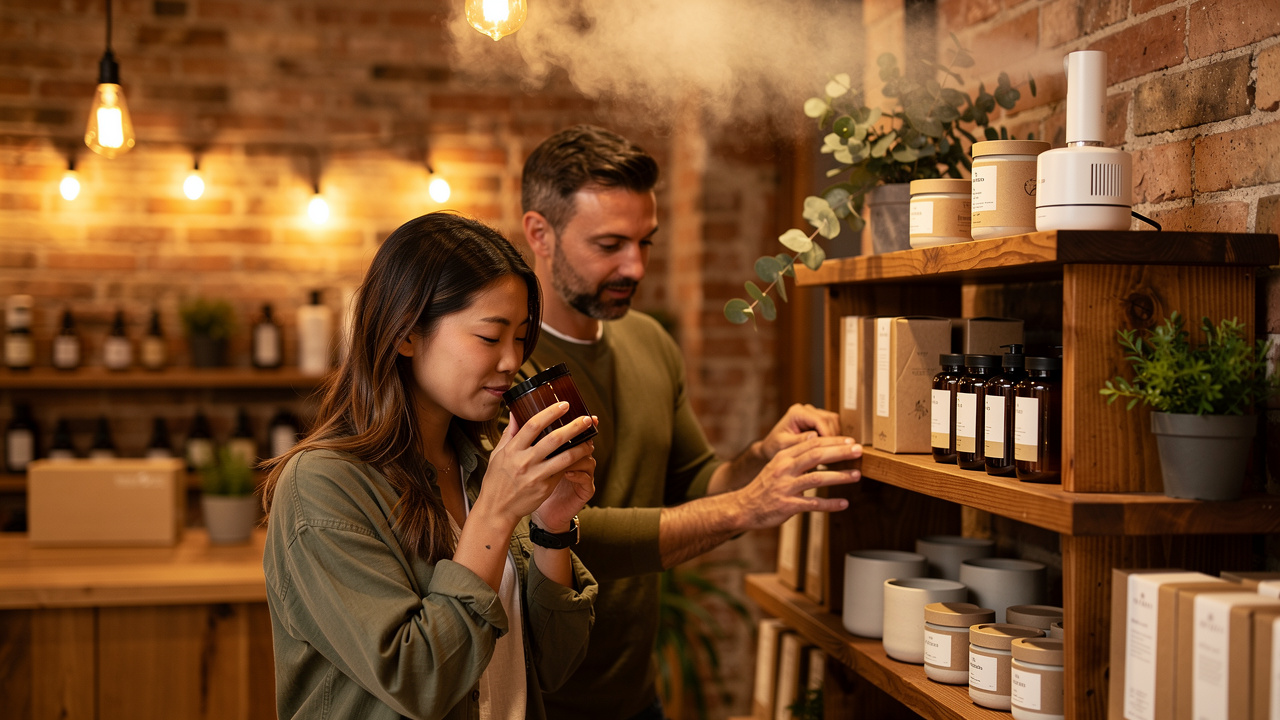
A signature scent is not an operating expense. It is a brand asset that accumulates equity over time — in the same category as a well-designed logo, a strong tagline, or a distinctive color palette. Every customer interaction that includes the signature fragrance deepens the emotional imprint, strengthens recognition, and reinforces loyalty.
For small and medium-sized businesses competing against better-funded rivals, scent branding offers something that no digital ad spend or visual rebrand can replicate: a sensory signal that cannot be easily copied — a principle that aligns with emerging thinking on New Brain Theory of imagination, which is reshaping how SMEs build differentiated, cognitively resonant brand strategies. A logo can be imitated. A color palette can be approximated. A proprietary signature scent, deployed consistently and tied to repeated positive experiences, is genuinely difficult to replicate.
Nonprofit organizations and community-facing brands can apply the same principle. A community health clinic, social services office, or donor event space that deploys thoughtful scent branding creates a more welcoming, emotionally resonant environment — one that deepens engagement and strengthens community relationships in ways that visual design alone cannot achieve.
For entrepreneurs building new brands, scent branding establishes emotional resonance from the very first customer interaction. In markets where visual and digital differentiation rarely feels sufficient, a distinctive olfactory identity is a meaningful early advantage.
The brands building their olfactory identities now are establishing a form of competitive differentiation that is durable, deeply personal, and stored in the most reliable part of human memory. That is not a small thing.
Frequently Asked Questions
Can Scent Branding Work for Online Businesses?
Online businesses cannot deploy scent in digital environments, but they can extend scent branding through physical touchpoints. Scent-infused product packaging, branded candles or room sprays included with orders, and fragrance-forward pop-up experiences are all viable approaches. E-commerce brands with any physical presence — retail partnerships, events, showrooms — should treat those environments as high-priority scent branding opportunities.
How Do I Choose the Right Scent for My Brand?
Start with your brand identity, not with fragrance samples. Define the emotional experience you want customers to associate with your brand, identify your target demographic, and work backward to a fragrance family that communicates those values. Use the fragrance family table in this guide as a starting framework, then work with a professional scent developer to refine the specific notes within that family.
Are There Legal Restrictions on Scent Branding?
A scent can be trademarked in the United States, but the legal bar is high. The fragrance must be distinctive — meaning it must function as a brand identifier rather than simply serving a utilitarian purpose. Very few scent trademarks have been successfully registered, though the legal landscape is evolving. Consulting with an intellectual property attorney familiar with non-traditional trademarks is advisable before pursuing scent trademark protection.
What Does Scent Branding Cost to Implement?
Costs vary based on the scope of the program. Custom signature scent development, commercial-grade diffusion hardware, fragrance cartridges or oils, and ongoing professional support all factor into the budget. Entry-level programs for a single boutique location can start in the low thousands annually. Multi-location programs with custom fragrance development represent a larger investment — but one that builds a proprietary brand asset rather than a recurring commodity expense. The measurable returns in dwell time, sales lift, and customer satisfaction consistently support the investment.
How Do I Measure Whether Scent Branding Is Working?
Establish baseline metrics before launch, then track changes after implementation. Relevant metrics include average transaction value, dwell time per visit, customer satisfaction scores, repeat visit frequency, and — for hospitality — cancellation rates and guest satisfaction survey results. Qualitative research through customer surveys and focus groups can capture changes in emotional association and brand perception that quantitative data alone may miss.
How Long Does It Take to See Results from Scent Branding?
Some effects — particularly changes in dwell time and immediate satisfaction scores — can appear within weeks of deployment. Deeper outcomes, like stronger brand recall and measurable loyalty shifts, develop over months of consistent exposure. Like all brand-building investments, scent branding delivers its strongest returns when deployed consistently over time rather than as a short-term experiment.
Conclusion
Scent branding works because it operates on the most direct sensory pathway to human emotion and memory. When a carefully developed signature fragrance is deployed consistently across your brand environment, it does something no visual ad or digital campaign can fully replicate: it encodes your brand in the emotional memory of every customer who walks through your door.
The business case is clear — measurable increases in dwell time, sales, satisfaction scores, and long-term loyalty have been documented across retail, hospitality, wellness, and healthcare. The strategic framework is accessible. And the competitive advantage — a proprietary sensory asset that competitors cannot easily copy — is genuine.
Whether you are a boutique retailer, a growing hotel brand, a nonprofit building community trust, or an entrepreneur establishing a new brand from the ground up, a thoughtfully developed scent branding strategy is one of the most durable investments you can make in your brand’s long-term identity.