
AI for Smbs: Reducing Operational Costs With Automation
AI technologies offer SMBs the opportunity to streamline operations and reduce operational costs through effective automation. By leveraging machine learning and natural language processing, businesses can identify repetitive tasks and automate workflows, leading to significant time savings and optimized resource allocation. The integration of AI tools enhances task prioritization and minimizes human error, ensuring more consistent processes. Additionally, ongoing performance monitoring helps businesses assess their automation initiatives' effectiveness. Understanding these benefits and implementation strategies can empower SMBs to enhance productivity and efficiency. Explore further insights to reveal the full potential of AI in your organization.
Key Takeaways
- AI automates repetitive tasks, significantly reducing time spent on manual processes and boosting team productivity.
- Integrating AI tools improves workflow optimization, enhancing task prioritization and resource allocation for cost savings.
- Employee satisfaction increases as automation reduces mundane workloads, leading to higher engagement and morale.
- Utilizing chatbots in customer service minimizes resource allocation while improving engagement and data security.
- Continuous performance monitoring ensures that AI solutions are effective, allowing for ongoing improvements in operational efficiency.
Understanding AI and Automation

Recognizing the rapid evolution of technology, small and medium-sized businesses (SMBs) are increasingly turning to artificial intelligence (AI) and automation to enhance operational efficiency and drive growth. Understanding the fundamentals of AI and the principles of automation is essential for SMBs looking to leverage these technologies effectively.
AI fundamentals encompass a range of techniques whereby machines simulate human intelligence. This includes machine learning, where algorithms learn from data inputs to improve decision-making over time, as well as natural language processing, which allows systems to interpret and respond to human language.
For SMBs, integrating AI can streamline processes, improving accuracy and speed in areas such as customer service and supply chain management.
Automation principles involve the use of technology to perform tasks with minimal human intervention. Key principles include process identification, where repetitive tasks are recognized and designated for automation; workflow design, which optimizes task execution through efficient sequencing; and monitoring, wherein systems continuously assess performance metrics.
Benefits of Automation for SMBs
Leveraging automation presents numerous advantages for small and medium-sized businesses (SMBs), markedly enhancing their operational capabilities and competitive edge. By implementing automated systems, SMBs can achieve significant time savings, allowing teams to focus on strategic initiatives rather than mundane tasks.
Automation contributes to workflow optimization by streamlining processes, which leads to improved task prioritization and resource allocation. The impact of automation extends to employee satisfaction, as it reduces repetitive workloads and promotes a more engaging work environment.
By minimizing mundane, time-consuming tasks, employees can devote more energy to creative and value-adding activities, consequently increasing productivity and morale. This shift not only enhances the workplace but positively influences the overall customer experience, as responsive service is paramount in today's fast-paced market.
Moreover, automation fosters process consistency, ensuring that operations adhere to established standards and protocols. This consistency leads to error reduction, minimizing mistakes that can adversely affect both employees and customers.
As operational efficiency increases, businesses can also gain a competitive advantage, positioning themselves favorably against rivals who may not be leveraging such innovations. Lastly, embracing automation enhances business agility, allowing SMBs to quickly adapt to changing market conditions or customer demands.
This flexibility is critical in maintaining relevance and fostering growth. In conclusion, the benefits of automation for SMBs are multifaceted, driving efficiency, satisfaction, and competitive positioning, ultimately paving the way for long-term success.
Identifying Repetitive Tasks

Identifying repetitive tasks is a crucial step for small and medium-sized businesses (SMBs) seeking to enhance productivity through automation. The process begins with thorough task analysis to pinpoint activities that consume excessive resources without adding significant value.
Workflow mapping plays an essential role here, as it visually delineates task sequences, highlighting redundancies and inefficiencies. Implementing effective process documentation is imperative to guarantee that tasks are standardized and adequately understood across the organization.
Employee feedback can provide invaluable insights into daily operations, revealing which tasks employees find monotonous and time-consuming. Coupling this with time tracking can help quantify how much time is spent on these repetitive tasks, facilitating a clearer assessment of their impact on productivity.
Additionally, software integration can streamline tasks that involve multiple applications, reducing the need for manual data entry. Role assessment allows businesses to identify which tasks can be delegated to junior staff or automated, thereby optimizing workforce utilization.
Moreover, data collection should be employed not only to track current workflow but also to inform prioritization strategies that align repetitive tasks with overall business goals. By identifying these tasks, SMBs can strategically approach task delegation and streamline processes, ultimately paving the way for a more efficient operational model.
Through this focused approach, businesses can liberate their resources, allowing employees to engage in more value-adding activities and enhance overall organizational efficiency.
AI Tools and Technologies
In the domain of small and medium-sized businesses (SMBs), the adoption of AI tools and technologies presents a significant opportunity to enhance operational efficiency. These innovations can dramatically streamline processes, reduce costs, and enable better decision-making, thereby freeing up valuable resources for strategic endeavors.
AI tools encompass a broad spectrum of automation technologies designed specifically to improve workflow automation. Among these, machine learning algorithms are instrumental in process optimization, allowing businesses to analyze trends and patterns that inform smarter operational choices.
Natural language processing (NLP) enhances communication, assists in customer service automation, and enables the development of chatbots that can handle queries efficiently.
Predictive analytics is another crucial component, leveraging historical data to forecast future trends and outcomes, thereby empowering SMBs to anticipate market demands and adjust their strategies accordingly.
Robotic process automation (RPA) further contributes to efficiency by automating repetitive tasks, reducing human error, and freeing employees to tackle more complex challenges.
Utilizing cloud solutions, SMBs can access intelligent systems that offer scalability and flexibility, ensuring that technology adapts to their evolving needs. This democratization of advanced technologies enables smaller enterprises to compete with larger organizations by leveling the playing field.
As SMBs explore these AI tools and technologies, they can realize substantial operational improvements, achieving both cost savings and enhanced productivity.
Embracing these innovations positions them to thrive in an increasingly competitive landscape, fostering growth and sustainability.
Implementing AI Solutions

Successfully implementing AI solutions in small and medium-sized businesses requires a structured approach that aligns technology with specific business objectives. The first step is conducting an AI readiness assessment to understand existing capabilities and identify gaps that need to be addressed. This assessment serves as a foundation for developing integration strategies that guarantee AI systems complement current workflows and processes.
Central to this initiative is the establishment of employee training programs to equip personnel with necessary skills, mitigating technology adoption barriers. These programs should incorporate user experience design principles to enhance usability and encourage adoption by the workforce.
Additionally, effective change management practices are essential to facilitate a smooth shift and foster a culture of innovation within the organization.
Selecting the right vendors is pivotal; applying stringent vendor selection criteria guarantees that chosen solutions meet required functionalities while addressing data privacy considerations.
Once implemented, organizations should set up performance monitoring systems to evaluate AI effectiveness continuously. This includes establishing feedback mechanisms that allow users to share insights and suggest improvements.
Cost-Effective AI Strategies
Implementing cost-effective AI strategies is essential for small and medium-sized businesses aiming to leverage technology without compromising their budget. By focusing on specific areas, SMBs can enhance efficiency, improve customer engagement, and ultimately reduce operational costs.
Here are three key strategies to reflect upon:
- Chatbot Integration: Deploying AI-driven chatbots for customer support can greatly enhance customer engagement while optimizing workflow. This reduces the need for extensive employee training and minimizes resource allocation for support teams.
- Data Analysis for Decision Making: Utilizing AI for data analysis allows businesses to make informed decisions. Through predictive maintenance, companies can identify when equipment requires attention, streamlining resource allocation and minimizing downtime. This astute approach to task prioritization helps businesses remain agile and responsive.
- Process Mapping and Workflow Optimization: By implementing process mapping tools, businesses can visualize and optimize workflows. This aids in identifying bottlenecks and inefficiencies, allowing for strategic planning that aligns with overall business objectives. Enhanced workflow optimization can lead to improved employee productivity and satisfaction.
Incorporating these cost-effective AI strategies enables SMBs to embrace digital transformation while maintaining budgetary constraints.
Real-World Case Studies
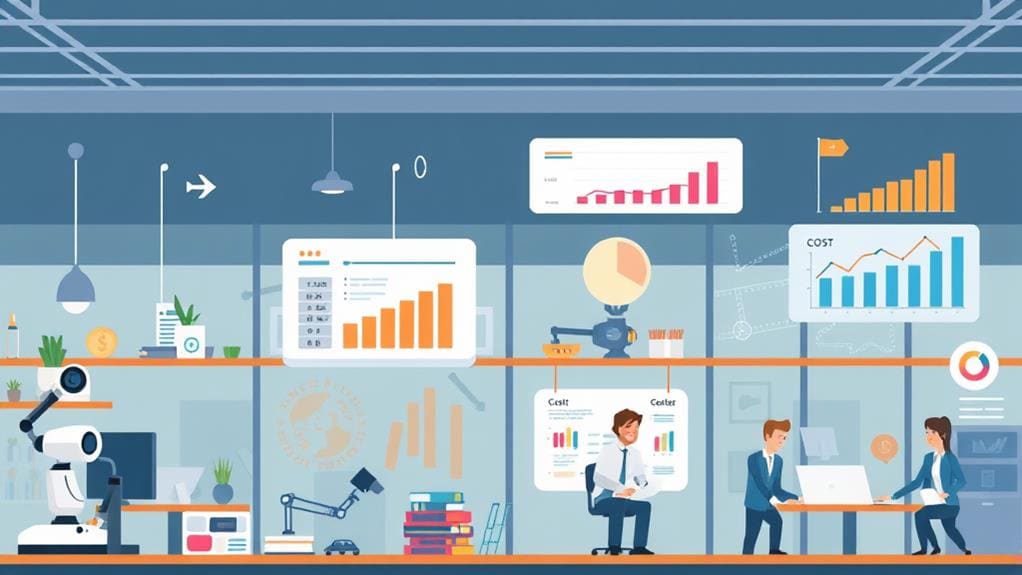
Real-world case studies illustrate the tangible benefits AI can bring to small and medium-sized businesses.
By evaluating increased efficiency metrics and cost reduction examples, organizations can identify best practices that enhance operational performance.
These success stories provide valuable insights into the practical applications of AI, informing future strategies for growth.
Increased Efficiency Metrics
AI technologies have demonstrated significant potential in enhancing operational efficiency among small and medium-sized businesses (SMBs). By leveraging advanced algorithms, these organizations can streamline processes and improve their performance benchmarks.
Several real-world case studies illustrate how AI-driven solutions yield measurable benefits:
- Workflow Analysis: SMBs utilizing AI for workflow analysis report a 30% increase in productivity metrics by identifying bottlenecks and optimizing routes for task completion.
- Time Savings: Automation tools have enabled significant time savings, with some businesses reporting reductions in manual processing time by up to 50%, allowing employees to engage in more strategic activities.
- Resource Allocation: Enhanced resource allocation powered by AI provides clear insights into task prioritization, facilitating better project management and improving employee engagement levels.
Through process optimization, these efficiencies translate into sustained operational excellence, enabling SMBs to thrive in competitive markets.
Incorporating AI not only fulfills immediate operational needs but also lays the foundation for continuous improvements, enhancing overall organizational performance while allowing owners the freedom to innovate and grow their enterprises.
Cost Reduction Examples
Cost efficiency has become a critical objective for small and medium-sized businesses (SMBs) as they navigate an increasingly competitive landscape. Implementing automation strategies can yield tangible cost reductions across various operational aspects.
One effective approach is outsourcing tasks that divert attention from core competencies. By delegating customer support or administrative work to specialized providers, SMBs can focus resources on innovation.
Additionally, streamlining processes through software integration allows for seamless communication between systems, reducing redundancies and improving workflow optimization.
Investing in employee training guarantees staff leverage new technologies effectively, enhancing productivity and decreasing errors. Data analysis tools can uncover insights into inventory management, which aids in minimizing excess stock while optimizing purchasing decisions.
Moreover, incorporating automation in financial forecasting can enhance accuracy, enabling SMBs to allocate funds more judiciously.
Marketing automation not only saves time but also increases precision in targeting audiences, reducing overall spend.
Together, these strategies create a robust framework for SMBs to not only cut costs but also enhance operational agility, leading to sustained competitiveness in the marketplace. Consequently, the integration of these automation techniques positions SMBs for long-term success amidst economic challenges.
Real-World Success Stories
Many small and medium-sized businesses (SMBs) have successfully adopted automation strategies, demonstrating considerable benefits that extend beyond mere cost reduction.
Effective implementation leads to enhanced customer engagement, streamlined processes, and improved employee satisfaction.
Here are three notable success stories:
- Retail Automation: A local retail chain adopted an automated inventory management system, which enabled process standardization and optimized resource allocation. This system improved workflow optimization by reducing stockouts, ensuring a better user experience for customers.
- Customer Service AI: An SMB in the service industry integrated AI-driven chatbots into their customer support. This not only enhanced data security by managing sensitive information better but also maintained high standards in change management and employee satisfaction, as staff could focus on complex queries rather than repetitive tasks.
- Training Program Automation: A technology startup implemented automated training programs for new employees. By streamlining onboarding processes, they achieved higher productivity levels and greater technology adoption among staff, considerably decreasing the time to proficiency.
These examples underscore the transformative impact of automation in fostering dynamic, resource-efficient SMBs that prioritize both operational efficiency and employee well-being.
Measuring Success and ROI
Measuring success and return on investment (ROI) is essential for small and medium-sized businesses (SMBs) implementing AI solutions. To effectively gauge the impact of automation, SMBs should establish clear ROI metrics that align with organizational objectives. These metrics serve as vital success indicators, enabling businesses to track progress and assess the overall effectiveness of AI initiatives.
One approach is to set performance benchmarks before implementation, which can facilitate thorough cost analysis post-automation. Key performance indicators (KPIs), such as process efficiency, time savings, and customer satisfaction, should be monitored to evaluate automation's impact on operational workflows.
The use of measurement tools, such as analytics platforms, can simplify data collection and analysis, providing a clearer picture of performance improvements.
Financial assessments are essential for determining the monetary benefits derived from AI investments. This includes calculating direct savings from reduced labor costs and indirect benefits like increased sales due to enhanced customer interactions.
Productivity gains achieved through automation can also be quantified, offering tangible evidence of ROI.
Ultimately, a structured approach to measuring success not only aids in justifying the initial investment but also supports ongoing evaluation and optimization of AI solutions. By focusing on defined metrics and establishing a robust framework for analysis, SMBs can navigate the complexities of ROI measurement and reveal the full potential of their automation endeavors, paving the way for sustained growth and improvement.
Overcoming Implementation Challenges

Implementing AI solutions in small and medium-sized businesses (SMBs) often presents various challenges that can hinder successful integration. Addressing these obstacles is critical to guarantee sustainable deployment and value creation.
To overcome implementation challenges, organizations must focus on several key areas:
- Change Management: A robust change management strategy is essential for aligning the organization's culture with new AI initiatives. This involves evaluating the current processes, identifying resistance factors, and fostering cultural alignment among employees.
- Employee Training: Equipping staff with the necessary skills to utilize AI technologies is crucial. Implementing extensive training programs guarantees that employees are not only familiar with the tools but can also advocate for their advantages. Continuous development can alleviate concerns about job security tied to automation.
- Stakeholder Engagement and Technology Integration: Engaging stakeholders early in the process can facilitate smoother technology integration. Regularly scheduled updates and collaborative sessions help in understanding user needs and evaluating risks associated with the shift.
Further actions, such as thorough risk evaluations and detailed process mapping, can assist in highlighting bottlenecks and defining clear pathways towards operational enhancement.
By prioritizing these elements, SMBs can navigate the complex landscape of AI implementation, circumventing potential pitfalls while promoting buy-in across all levels of the organization.
With strategic focus and commitment, businesses can reveal the transformative potential of AI, driving efficiency and reducing operational costs.
Future of AI in SMBs
The future of AI in SMBs promises significant efficiency gains through streamlined operations and automation tools that are increasingly scalable.
These advancements will enable businesses to leverage enhanced decision-making insights, driving improved strategic outcomes.
As AI technologies continue to evolve, SMBs must adapt to harness these benefits effectively.
AI-Driven Efficiency Gains
AI technologies are increasingly pivotal in driving efficiency gains for small and medium-sized businesses (SMBs). Through effective AI adoption, businesses can optimize workflows, streamline processes, and enhance overall productivity. The following key strategies highlight AI's role in delivering tangible benefits:
- Task Prioritization: AI systems can evaluate tasks by urgency and importance, ensuring resources are allocated effectively to high-impact activities.
- Data Integration: By consolidating information from disparate sources, AI enables a cohesive data landscape, enhancing decision-making through extensive insights.
- Performance Monitoring: AI tools can constantly track employee performance and business metrics, allowing for real-time adjustments, which improves productivity and minimizes operational risks.
Furthermore, investing in AI-driven employee training enhances skillsets, ultimately fostering innovation potential.
As SMBs leverage AI for customer engagement, they gain the ability to personalize interactions and respond quickly to market shifts.
Regarding risk management, predictive analytics generate foresight into potential challenges, allowing businesses to mitigate risks proactively.
Scalability of Automation Tools
Scalability represents a fundamental aspect for small and medium-sized businesses (SMBs) seeking to harness the full potential of automation tools in an evolving digital landscape. As these businesses embrace automation, they often encounter scalability challenges that can impede growth adaptability.
Initially, understanding the automation limits of their existing infrastructure is essential to mitigate these challenges. Flexible solutions that accommodate rapid changes in demand are imperative.
Businesses must assess their resource allocation strategies to optimize both human and technological resources, allowing for seamless scaling. However, integration hurdles may arise when aligning new automation tools with legacy systems, hindering efficiency and process standardization.
The evolution of technology continues to offer robust frameworks that support scalable automation. Implementing performance metrics can aid in monitoring the effectiveness of these systems, ensuring that they meet the evolving needs of the business without incurring prohibitive cost implications.
Enhanced Decision-Making Insights
Harnessing automation tools not only enables scalability but also enhances decision-making insights for small and medium-sized businesses (SMBs). By leveraging advanced technologies, SMBs can transform raw data into actionable intelligence, empowering leaders to make informed strategic choices.
Key benefits of AI-driven decision-making insights include:
- Data Visualization: Simplifies complex data sets, making patterns easily discernible, which aids in quick comprehension and analysis.
- Predictive Analytics: Allows SMBs to forecast future trends and customer behavior by analyzing historical data, thereby optimizing resource allocation and strategic forecasting.
- Scenario Modeling: Facilitates risk assessment and evaluation of various business scenarios, enabling companies to prepare for potential challenges.
Integrating these insights into everyday operations leads to improved performance benchmarking and audience segmentation.
SMBs can derive customer insights more effectively, ensuring that marketing strategies align with customer preferences. By employing trend analysis, businesses can stay ahead of market demands, ensuring they adapt promptly.
Frequently Asked Questions
How Secure Is Data When Using AI for Automation?
When using AI for automation, data security is paramount. Implementing robust data encryption mechanisms is vital to protect sensitive information from unauthorized access.
In addition, adherence to established compliance standards, such as GDPR or HIPAA, guarantees that data handling practices meet regulatory requirements, enhancing trust among users.
Organizations must regularly assess their security frameworks and update their practices to mitigate potential vulnerabilities, thereby promoting a secure environment conducive to operational freedom and innovation.
Can Small Businesses Afford Custom AI Solutions?
The affordability of custom AI solutions for small businesses hinges on a thorough cost-benefit analysis. While initial investments can be intimidating, the long-term gains often outweigh immediate costs.
Scalability considerations play an essential role; as businesses grow, a tailored AI system can adapt to evolving needs, enhancing operational efficiency.
Ultimately, small businesses must evaluate their unique circumstances and potential returns to determine if custom AI solutions align with their goals for innovation and freedom.
What Skills Are Needed to Manage AI Tools?
To effectively manage AI tools, professionals must cultivate a blend of essential skills.
AI literacy is vital for understanding tool capabilities, while tool integration expertise guarantees seamless implementation.
Proficiency in data analytics enables informed decision-making, and change management skills facilitate organizational adaptation.
Additionally, ethical considerations must be prioritized to navigate AI implications responsibly.
Is AI Suitable for All Types of Smbs?
While some may argue that artificial intelligence is exclusively beneficial for large enterprises, the reality is that AI can revolutionize operations across various small and medium-sized businesses (SMBs).
AI benefits span numerous industry applications, from automating customer service to optimizing supply chains.
By leveraging tailored AI solutions, SMBs can harness efficiency, reduce costs, and enhance decision-making processes.
Ultimately, embracing AI offers the freedom to innovate and adapt in competitive markets.
How Do I Choose the Right AI Vendor?
Choosing the right AI vendor necessitates a thorough vendor evaluation process.
Begin by evaluating the vendor's technical capabilities, reputation, and customer support services.
Additionally, consider potential integration challenges such as compatibility with existing systems and the learning curve for staff.
Engage stakeholders throughout the selection process to guarantee alignment with business objectives.
Conclusion
To summarize, the integration of artificial intelligence in small and medium-sized businesses holds the potential to markedly reduce operational costs through automation. Much like a well-tuned engine, which operates more efficiently when unnecessary components are removed, SMBs can streamline operations by identifying and automating repetitive tasks. As organizations embrace these technologies, a shift towards a more agile and cost-effective future becomes evident, ultimately positioning themselves for sustained growth and competitive advantage in an increasingly automated landscape.