
AI Implementation: The Secret to SMB Agility
AI implementation serves as an essential catalyst for small and medium-sized businesses (SMBs) working towards agility in today's fast-paced environment. By automating routine tasks and enhancing decision-making through data-driven insights, SMBs can streamline operations and reduce costs. The successful adoption of AI requires a clear assessment of current capabilities, resource limitations, and staff training to overcome potential barriers. Additionally, integrating the right AI tools into workflows fosters collaboration and operational efficiency. For those looking to stay competitive, understanding the latest trends in AI will be crucial for long-term growth and innovation.
Key Takeaways
- AI automates routine tasks, significantly enhancing operational efficiency and driving cost savings for SMBs.
- Data-driven insights from AI improve decision-making, reducing errors and providing a competitive edge.
- Assessing resource limitations, including budget and skills, is essential for effective AI implementation.
- Effective data management and security frameworks are crucial for successful AI initiatives.
- Training staff for AI use fosters collaboration and accelerates the adoption of new technologies.
Understanding AI for SMBs

As businesses increasingly seek to leverage technology for enhanced competitiveness, understanding artificial intelligence (AI) becomes essential for small and medium-sized businesses (SMBs). At its core, AI refers to the simulation of human intelligence in machines programmed to think and learn. For SMBs, grasping the AI fundamentals can open new pathways to optimize operations, refine customer interactions, and innovate product offerings.
However, the journey toward effective AI implementation hinges on SMB readiness. This encompasses the infrastructural capabilities, workforce skill sets, and organizational mindset required to successfully adopt AI technologies. It is not merely about investing in sophisticated tools; rather, it involves evaluating existing processes, data quality, and the cultural inclination toward technology adoption.
In this way, a pragmatic approach requires SMBs to conduct thorough audits of their current capabilities and identify the areas of AI implementation that will yield the highest impact for their business.
Moreover, while the allure of AI is compelling, it is vital for SMBs to recognize the limitations and ethical challenges associated with its deployment. Businesses must foster a culture of continuous learning, encouraging employees to embrace change and adapt to intelligent systems. Additionally, maintaining transparency and accountability in AI applications is essential to build trust among stakeholders.
Ultimately, a well-informed understanding of AI, combined with strategic alignment and readiness, will empower SMBs to navigate their unique challenges and harness the transformative potential of artificial intelligence.
Benefits of AI Adoption
While many SMBs may hesitate to commence on the AI adoption journey due to perceived complexities, the benefits can greatly outweigh the initial challenges faced. AI technologies can drive significant cost savings by automating routine tasks and streamlining workflows, allowing businesses to allocate resources more effectively.
This operational efficiency enhances decision-making capabilities, as data-driven insights lead to informed strategies and reduced errors.
In addition, adopting AI can provide a competitive advantage in rapidly evolving markets. Small to medium-sized businesses can harness customer insights gleaned from advanced analytics to tailor offerings, enhancing market responsiveness and fostering customer loyalty.
Moreover, the scalability benefits of AI mean that as an SMB grows, its AI solutions can adapt seamlessly to accommodate increased demands.
Risk management is another area where AI proves invaluable. Predictive analytics can forecast potential challenges, enabling proactive measures to mitigate risks.
Additionally, by enhancing talent acquisition processes, AI can identify the right candidates, facilitating a more skilled and agile workforce that drives innovation potential.
Ultimately, the transformative power of AI empowers SMBs to not only survive but thrive in a competitive landscape.
By embracing this technology, these businesses can reveal latent opportunities, ensuring they remain agile and resilient.
In a world where change is constant, AI stands as a key enabler, fostering adaptability and positioning SMBs for long-term success.
The journey may be challenging, but the rewards of AI adoption propel forward-thinking businesses towards an empowered future.
Assessing Your Business Needs

Evaluating your business needs is an essential first step in AI implementation, focusing on identifying vital business areas that can benefit from enhanced efficiency and productivity.
Concurrently, understanding resource limitations—both financial and human—ensures that AI initiatives are not only aligned with strategic goals but also feasible within operational constraints.
This thoughtful approach allows SMBs to prioritize solutions that deliver measurable impact while optimizing resource allocation.
Identifying Critical Business Areas
How can small and medium-sized businesses (SMBs) strategically pinpoint their most critical operational areas to implement AI effectively? To achieve this, SMBs must undertake a thorough assessment of their current business landscape.
Begin with market analysis to identify trends that impact customer experience and operational efficiency, while revealing areas ripe for improvement.
Next, evaluate decision-making processes to uncover opportunities for automation and enhanced data analytics. By focusing on risk management, businesses can better understand potential vulnerabilities and apply AI to mitigate these risks, ensuring a robust operational framework.
Key areas include customer service, where AI can drive customer satisfaction, and internal processes that benefit from cost reduction and process optimization.
Additionally, fostering employee engagement through AI-driven tools can elevate team collaboration and productivity.
Ultimately, embracing innovation strategies that leverage AI can create a significant competitive advantage, positioning SMBs for long-term success.
Understanding Resource Limitations
A clear understanding of resource limitations is essential for SMBs looking to implement AI solutions effectively. Resource allocation requires precise decision-making, particularly when maneuvering budget constraints. AI initiatives often incur high upfront costs, and without a solid financial framework, these projects can quickly become untenable.
Moreover, skill gaps within the organization can stifle progress. Identifying existing technological limitations is vital; without an adaptable infrastructure, new AI tools may not integrate seamlessly.
Time management is another important factor, as many teams face change resistance, delaying the onboarding of innovative technologies.
When considering vendor selection, SMBs must weigh potential partnerships against their resource capabilities, ensuring alignment with their specific business needs. Process optimization through AI should be framed as an opportunity for increased employee engagement rather than an imposition, fostering a culture open to innovation.
Lastly, investing in training resources prepares employees to embrace AI, mitigating anxiety and resistance during the shift. By evaluating these resource limitations, SMBs can strategically position themselves to harness AI's potential, leading to greater agility and competitive advantage in a rapidly evolving marketplace.
Identifying Suitable AI Tools
Which factors should small and medium-sized businesses (SMBs) consider when identifying suitable AI tools? In an increasingly complex AI tools landscape, the first step lies in establishing concise tool selection criteria tailored to specific business needs.
SMBs should prioritize industry-specific solutions that enhance operational efficiency while aligning with their strategic objectives.
Budget considerations play a significant role; selecting tools that deliver value without undermining financial stability is imperative. Cost-effective solutions do not equate to diminished performance—a keen analysis of scalability options allows SMBs to invest in tools that can grow alongside their business.
User-friendly interfaces are essential; intuitive software promotes ease of use, guaranteeing staff can capitalize on AI's benefits without extensive training.
Can the chosen AI tools integrate seamlessly with existing systems? Evaluating integration capabilities is critical to mitigate disruption and maintain productivity during the changeover. Engaging in vendor comparisons can illuminate the various options available, aiding informed decision-making.
Furthermore, proactive measures such as trial evaluations allow businesses to test AI tools in real-world scenarios, confirming they meet operational expectations before full implementation.
Integrating AI Into Workflows

Successful identification of suitable AI tools lays the foundation for meaningful integration into business workflows. To effectively harness AI's potential, organizations must prioritize workflow optimization to streamline various activities. This involves evaluating existing processes and identifying areas where task automation can enhance productivity. By leveraging AI for routine tasks, teams can focus on high-value strategic initiatives that drive growth.
Process integration is essential; teams must seamlessly incorporate AI solutions into daily operations while ensuring technology alignment with overarching business objectives. This alignment facilitates team collaboration, promoting a culture where members work in unison to achieve common goals. Through efficient communication channels, feedback loops can be established, allowing for real-time insights that drive decision-making.
Emphasizing efficiency enhancement, organizations can foster a culture of continuous improvement. Utilizing data analytics capabilities built into AI tools, businesses can better monitor performance and measure the impact of AI-driven changes. By embracing a change management strategy, leaders can cultivate an adaptable environment that encourages innovation and minimizes resistance.
Moreover, as small and medium-sized businesses (SMBs) evolve, scalability solutions become paramount. AI implementation should be designed to grow with the organization, ensuring that processes remain efficient as demands change.
Data Management and AI
Effective data management forms the backbone of any successful AI initiative, as the quality and accessibility of data directly influence the performance of AI systems. Organizing data within a robust data architecture guarantees that SMBs can harness the full potential of AI technologies. This entails establishing data governance frameworks that encapsulate data quality, security, and compliance. By prioritizing these elements, businesses can create a reliable foundation for AI applications.
Central to effective data management is the integration of disparate data sources. Data integration enables seamless access to both structured and unstructured data, promoting data accessibility that is vital for timely and informed decision-making. Furthermore, businesses must employ strong data security measures that not only protect sensitive information but also promote data privacy. This protects both the organization and its customers, thereby enhancing trust.
Data visualization tools aid in transforming complex datasets into comprehensible formats, facilitating deeper insights and faster response times. This visualization not only empowers teams but also enhances collaborative efforts across departments, ultimately driving agility. Additionally, maintaining rigorous data compliance with industry regulations further solidifies the integrity of the data management process.
Investing in scalable data storage solutions is equally essential to support the growing volumes of data streamed in from various sources. Through meticulous attention to data management practices, SMBs can reveal the true potential of AI, creating an environment that fosters innovation, responsiveness, and market adaptability.
A strong commitment to these principles will ultimately pave the path for sustainable growth in an ever-evolving landscape.
Training Staff for AI Use
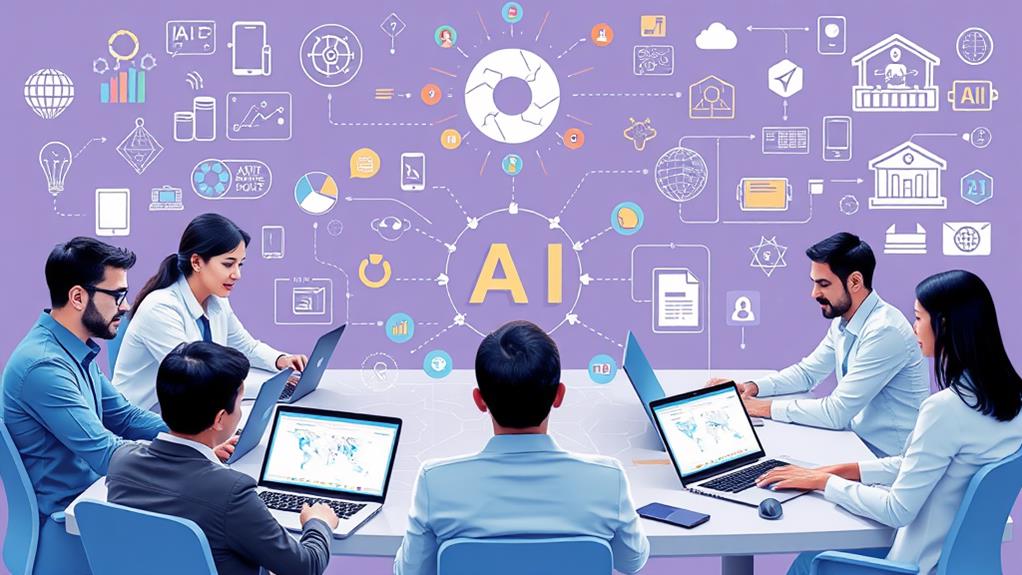
As the foundation of AI initiatives is solidified through robust data management practices, the focus shifts to another pivotal aspect: empowering staff to leverage these technologies effectively.
Enabling employees through targeted training enhances AI literacy across the organization, fostering an environment where staff engagement is not just encouraged but expected. This transformation requires a commitment to continuous learning and skill development, equipping the workforce to adapt to technological advancements.
Strategic change management is essential during this process. By creating an open forum for knowledge sharing, organizations can enhance team collaboration, ensuring that insights and best practices flow seamlessly among employees.
Encouraging a culture of shared learning not only bolsters individual capabilities but also amplifies collective intelligence, driving technology adoption at every level.
To facilitate this evolution, businesses must invest in extensive training resources that cater to varying skill levels and learning styles. From workshops to e-learning platforms, these resources should be tailored to the unique needs of each team, allowing for an individualized approach.
Additionally, fostering employee empowerment means giving staff the autonomy to explore AI tools and apply their learning innovatively in their roles.
Measuring Success and Impact
Measuring the success and impact of AI implementation within small and medium-sized businesses (SMBs) is a multifaceted endeavor that requires a strategic framework. To effectively evaluate the effectiveness of AI initiatives, organizations must establish clear success metrics that align with their overall business objectives. These metrics should encompass both quantitative and qualitative dimensions, enabling businesses to conduct thorough impact assessments.
Performance indicators serve as essential benchmarks against which progress can be measured. This may include metrics related to productivity enhancements, cost savings, customer satisfaction, and revenue growth. By employing outcome evaluation techniques, SMBs can analyze the tangible benefits derived from AI, determining whether the investment aligns with anticipated returns.
A thorough ROI analysis is important to understanding the financial implications of AI technologies. It provides a clear picture of the investment's worth, reinforcing the need for transparency and accountability in the implementation process.
Additionally, user feedback plays an integral role in measuring success; understanding employee experiences with AI tools can reveal areas for improvement and further innovation.
As SMBs benchmark progress, they should continuously refine their strategic alignment, ensuring that AI initiatives evolve in tandem with business goals. This iterative process fosters agility, allowing businesses to adapt and grow within a dynamic market landscape.
Ultimately, prioritizing a holistic approach to measuring success and impact can empower SMBs to harness the full potential of AI, driving sustainable growth and competitive advantage.
Overcoming Implementation Challenges

Although implementing AI in small and medium-sized businesses (SMBs) offers numerous benefits, it is often accompanied by significant challenges that can hinder success. One of the most notable obstacles is the development of robust implementation strategies that align with the unique needs of the organization.
Common pitfalls, such as inadequate risk assessment and poor change management, can lead to resistance among staff and ultimately derail initiatives.
To navigate these challenges, effective team collaboration is vital. Engaging employees early in the process fosters a culture of acceptance, making it easier to obtain essential stakeholder buy-in. A transparent approach encourages feedback loops that allow for continuous refinement of the AI systems in place.
In addition, gradual adoption through pilot programs can minimize disruption, allowing for adjustments based on initial findings.
Resource allocation also plays an important role in the successful implementation of AI. SMBs should evaluate both financial and human resources to guarantee that sufficient support is available to complete the project.
Moreover, establishing clear metrics for success during pilot programs can pave the way for scaling AI initiatives across the enterprise.
Future Trends in AI for SMBs
As small and medium-sized businesses (SMBs) look to the future, the integration of AI is poised to revolutionize their operations through enhanced data analytics, streamlined automation, and personalized marketing strategies.
By harnessing these technologies, SMBs can not only optimize their processes but also tailor customer experiences to foster loyalty and drive growth.
Understanding these trends will be vital for businesses aiming to maintain competitiveness in an increasingly tech-driven market.
Enhanced Data Analytics
A considerable number of small and medium-sized businesses (SMBs) are set to experience transformative shifts in their operations through enhanced data analytics powered by artificial intelligence (AI). This shift will allow SMBs to leverage data visualization techniques and predictive analytics to extract valuable real-time insights, facilitating informed decision-making processes.
With advanced analytical tools, businesses can conduct effective customer segmentation, customizing their offerings to address increasingly diverse consumer needs. Enhanced performance metrics will drive businesses to assess their operations with greater precision, allowing for robust trend analysis that identifies emerging patterns and opportunities within the market landscape.
Additionally, the integration of AI-driven data analytics will greatly bolster market research capabilities. By systematically analyzing vast data sets, SMBs can uncover hidden insights while simultaneously performing risk assessments that help mitigate uncertainties.
This thorough examination of analytics will not only improve operational efficiency but also empower businesses to make agile strategic decisions in an ever-evolving marketplace. In this age of data, the capacity to harness enhanced data analytics will be pivotal for SMBs aiming to thrive and carve out a competitive edge.
Streamlined Operations Automation
The future of small and medium-sized businesses (SMBs) lies in the effective implementation of streamlined operations automation, driven by advancements in artificial intelligence (AI). As SMBs seek to remain agile in a competitive landscape, process optimization becomes paramount.
AI facilitates seamless task delegation, allowing teams to focus on high-value activities rather than mundane tasks. By enhancing workflow efficiency, AI tools can markedly improve resource allocation, enabling businesses to utilize their assets more effectively. The result is substantial time savings and error reduction, promoting operational consistency across various functions.
Moreover, AI-powered decision support systems empower leaders with real-time insights for informed decision-making, fostering a proactive approach to challenges. Performance tracking capabilities further enhance operational visibility, allowing businesses to assess their strategies and adapt in a dynamic market.
Ultimately, the integration of streamlined operations automation not only boosts cost efficiency but also cultivates a culture of continuous improvement within SMBs. Embracing these trends means liberating enterprises to innovate and grow with confidence, ensuring they remain resilient and responsive to ever-evolving consumer demands.
Personalized Marketing Strategies
Utilizing advanced AI technologies, small and medium-sized businesses (SMBs) can greatly enhance their marketing efforts through personalized strategies tailored to individual consumer preferences. By leveraging data analytics, SMBs can effectively perform customer segmentation, identifying unique characteristics within their target audience. This approach enables businesses to engage consumers in meaningful ways, enhancing user experiences and driving brand loyalty.
Behavior analysis plays an essential role in understanding how customers interact with products and services, allowing for the refinement of marketing strategies. With AI, SMBs can achieve campaign optimization by evaluating engagement metrics and implementing content personalization that resonates with specific demographic insights. This guarantees that consumers receive marketing messages that are relevant and timely.
Moreover, effective conversion tracking allows SMBs to evaluate the success of these personalized strategies, creating valuable feedback loops. By continuously iterating on their tactics based on consumer behavior, businesses can maintain agility in their marketing efforts.
As AI technology evolves, the ability to deliver hyper-personalized marketing will become increasingly significant for SMBs, empowering them to navigate competitive landscapes while fostering strong customer relationships.
Frequently Asked Questions
What Are Some Common Misconceptions About AI for Smbs?
Common misconceptions about AI often cloud the understanding of its implementation in small to medium-sized businesses (SMBs).
Frequently, AI myths suggest that these enterprises lack the readiness for deployment, ignoring their potential to adapt.
Perceived costs can deter investment despite long-term benefits.
Additionally, skill gaps may obscure the understanding of AI's misunderstood capabilities, leading SMBs to underestimate how AI can address their unique challenges and enhance operational efficiency.
How Can AI Improve Customer Engagement for Small Businesses?
AI enhances customer engagement for small businesses by enabling personalized marketing strategies that resonate with individual preferences.
By analyzing customer data, businesses can tailor promotions and content, fostering deeper connections.
Additionally, automated responses streamline communication, allowing businesses to address inquiries swiftly and efficiently, enhancing customer satisfaction.
This combination empowers small enterprises to deliver a more engaging experience, ensuring they meet the evolving expectations of their clientele and build enduring loyalty.
Are There Specific Industries That Benefit More From Ai?
Certain industries indeed benefit more profoundly from AI technologies.
In manufacturing, automation enhances efficiency and reduces costs.
Retail analytics leverages consumer data to optimize inventory and personalize marketing strategies.
Healthcare optimization utilizes AI for diagnostics and patient management, improving outcomes while streamlining operations.
Similarly, financial forecasting employs AI algorithms to predict market trends, aiding businesses in making informed decisions.
Collectively, these sectors demonstrate the transformative potential of AI, offering strategic advantages to those who adopt it.
What Costs Are Typically Involved in Implementing AI Solutions?
Implementing AI solutions entails various costs that organizations must consider. Initial investments are necessary for software licensing and integration costs.
Ongoing maintenance guarantees the system operates efficiently, while training requirements are essential for employee adaptation.
In addition, scalability challenges can arise as the organization grows. Employee resistance may emerge, complicating implementation.
Careful vendor selection is critical in managing these factors effectively, thereby facilitating a smoother shift towards an AI-enhanced operational framework.
How Can SMBS Protect Their Data When Using AI Tools?
In a world reminiscent of the Trojan Horse, where hidden vulnerabilities lurk, SMBs must prioritize data protection when leveraging AI tools.
Effective strategies include robust data encryption to safeguard sensitive information, adherence to privacy regulations to avoid compliance pitfalls, thorough employee training to foster a security-conscious culture, and regular risk assessments to identify potential threats.
Conclusion
The successful implementation of AI within small and medium-sized businesses (SMBs) presents both challenges and opportunities. While initial hurdles may obstruct progress, the long-term benefits of agility and efficiency can transform operational landscapes. Evaluating needs and integrating suitable tools fosters a dynamic workflow, empowering employees with the necessary skills. As AI continuously evolves, so too must the strategies of SMBs, ensuring relevance in an increasingly competitive environment. Ultimately, the balance between caution and innovation will dictate future success.