
How AI Is Driving Innovation in SMBS
AI is revolutionizing small and medium-sized businesses (SMBs) by streamlining operations and enhancing customer experiences. Through automation, SMBs can optimize workflows, reduce routine tasks, and make data-driven decisions, greatly boosting productivity. AI enables personalized customer interactions by analyzing consumer behavior and preferences, leading to tailored recommendations that drive engagement and loyalty. Additionally, predictive analytics allow SMBs to adapt to market trends and customer needs in real-time. As these technologies evolve, SMBs must navigate implementation challenges and resource constraints to fully harness AI's potential for sustained innovation and growth. Explore further insights into this transformative journey.
Key Takeaways
- AI enhances operational efficiency by optimizing workflows and automating routine tasks, allowing SMBs to focus on core activities and innovation.
- Data-driven decision-making powered by AI enables SMBs to analyze performance metrics and market trends for strategic planning and competitive edge.
- Personalized customer experiences through AI-driven insights foster brand loyalty and increase engagement by tailoring solutions to individual needs.
- Seamless integration of AI technologies improves collaboration and communication among teams, driving productivity and innovative thinking within the workforce.
- Predictive analytics helps SMBs anticipate market shifts and manage resources effectively, ensuring they remain adaptive in a competitive landscape.
Understanding AI in SMBs
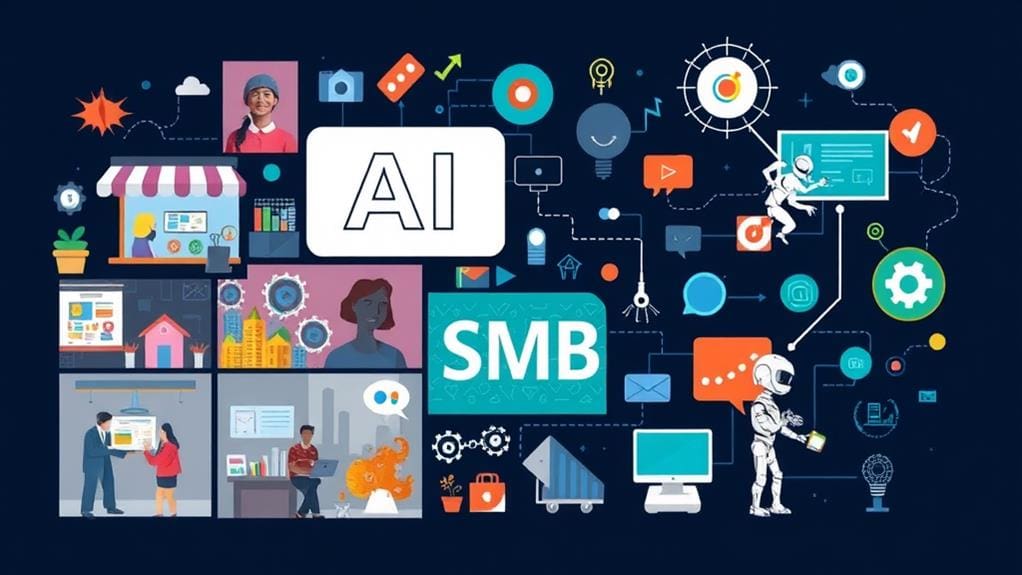
As we explore the landscape of small and medium-sized businesses (SMBs), it becomes clear that understanding artificial intelligence (AI) is essential for their growth and competitiveness. AI education is critical for SMBs; workforce training can empower employees with the skills necessary to utilize AI tools effectively.
However, the ethical implications of AI use remain a significant concern, necessitating careful consideration of biases and fairness in algorithms.
The implementation challenges facing SMBs can be intimidating. Many organizations grapple with cost considerations when adopting AI technologies, which may seem prohibitive, particularly for those operating on limited budgets. Identifying industry-specific applications can lead to more effective investment, allowing SMBs to leverage AI solutions tailored to their unique operational needs.
An overview of AI tools highlights resources ranging from machine learning applications to customer relationship management systems, providing organizations with diverse options.
Additionally, understanding the workforce impact of AI adoption is essential; while some roles may evolve, others may require reskilling or may even be replaced.
However, the potential competitive advantages of AI adoption far outweigh the risks, as businesses can optimize operations, enhance decision-making, and create personalized customer experiences.
Effective adoption strategies—such as phased integration methods and pilot projects—can mitigate risks and foster a smooth shift.
Ultimately, a robust approach to understanding AI in SMBs will not only enable survival but also pave the way for sustained innovation and market leadership.
Streamlining Operations With AI
Streamlining operations with AI can lead to significant improvements for small and medium-sized businesses (SMBs), enabling them to enhance efficiency and reduce costs. By leveraging AI technologies, SMBs can optimize workflows, automate routine tasks, and improve decision-making processes.
However, successfully implementing these solutions entails maneuvering through various AI implementation challenges, including integration techniques and technology adoption barriers.
To achieve effective AI integration, businesses must carefully evaluate vendor selection criteria to guarantee alignment with their specific operational needs. Additionally, industry-specific applications of AI can provide tailored solutions that address unique challenges faced by different sectors. For example, manufacturing SMBs might benefit from predictive maintenance systems that enhance equipment longevity, while retail businesses could employ AI for inventory management and personalized marketing.
Moreover, fostering a culture of innovation is essential for the success of AI initiatives. This involves robust employee training programs that equip staff with the necessary skills to operate new technologies and understand their benefits.
Change management strategies also play a critical role in smoothing the shift and guaranteeing employee buy-in. By addressing concerns and emphasizing the advantages of AI, businesses can mitigate resistance and enhance overall adoption.
Enhancing Customer Experience
As small and medium-sized businesses (SMBs) increasingly adopt AI technologies, the enhancement of customer experience becomes a pivotal focus.
Personalized interaction strategies, streamlined communication channels, and predictive analytics applications allow SMBs to tailor their services and respond proactively to customer needs.
This transformation not only builds stronger customer relationships but also drives competitive advantage in an ever-evolving marketplace.
Personalized Interaction Strategies
Personalized interaction strategies have emerged as a cornerstone in enhancing customer experience for small and medium-sized businesses (SMBs). By leveraging AI-driven insights, these businesses can implement effective customer segmentation strategies that allow for deeper understanding of their audiences. This facilitates the creation of tailored marketing campaigns that resonate personally with customers, ultimately driving loyalty and satisfaction.
Employing personalized interaction strategies offers several distinct advantages:
- Customer Insights: Understand customer preferences and behavior to craft individualized experiences.
- Tailored Solutions: Create product recommendations and marketing messages that cater to specific customer needs.
- Increased Engagement: Foster more meaningful interactions through targeted communication, promoting brand loyalty.
- Data-Driven Decisions: Use analytics to adapt strategies in real-time, guaranteeing relevance and responsiveness to customer desires.
Incorporating these strategies enables SMBs to break through the noise of a crowded marketplace, allowing them to offer a unique value proposition.
By focusing on personalized interactions, these businesses can nurture stronger relationships with their customers, elevating their overall experience and positioning themselves for sustainable growth.
The capacity to engage authentically guarantees that SMBs remain competitive in an ever-evolving economic landscape.
Streamlined Communication Channels
Effective communication serves as the backbone of customer relationships, and SMBs have begun to recognize the importance of streamlined communication channels in enhancing customer experience. By leveraging virtual collaboration tools, organizations can facilitate remote team engagement and foster a more connected workforce, which ultimately reflects positively on client interactions.
The advantages of messaging automation benefits cannot be understated; they enhance responsiveness while reducing the potential for errors. Cross-platform integration guarantees that communication flows seamlessly across various applications, creating a cohesive environment for both teams and customers. AI chatbots improve efficiency by providing instant responses to frequently asked questions, contributing to communication barrier reduction.
Furthermore, real-time feedback systems empower businesses to address concerns immediately, enhancing customer satisfaction. Team communication optimization is achieved through AI-driven meeting scheduling, allowing SMBs to save precious time and resources.
Knowledge sharing platforms also support sustainable collaboration by centralizing critical information, assuring that teams remain informed and agile.
Predictive Analytics Applications
The power of predictive analytics is reshaping how small and medium-sized businesses (SMBs) engage with their customers, providing insights that drive enhanced experiences. By analyzing customer behavior and deciphering market trends, SMBs can tailor their offerings and interactions to meet specific needs, thereby improving customer satisfaction and loyalty.
With predictive analytics, businesses can leverage data in various impactful ways:
- Sales Forecasting: Anticipating future sales allows for responsive strategies that align with customer demand.
- Risk Assessment: Identifying potential issues and making informed decisions enables companies to mitigate risks proactively.
- Inventory Management: Adapting inventory levels according to predictive insights guarantees that businesses can meet customer needs without overstocking.
- Competitive Analysis: Understanding competitors' positioning helps SMBs craft unique strategies to differentiate themselves in the market.
Moreover, predictive analytics aids in financial modeling and enhancing operational efficiency, giving businesses a distinct advantage.
As SMBs weave these advanced analytics into their customer engagement strategies, they foster deeper connections and create a more personalized, responsive environment that speaks to the desires of their clientele.
Data-Driven Decision Making
In today's fast-paced business environment, data-driven decision making has emerged as a vital strategy for small and medium-sized businesses (SMBs) aiming to enhance their competitive edge. The integration of advanced analytics, particularly through AI, empowers SMBs to harness vast amounts of data, transforming it into actionable insights that drive strategic initiatives.
One of the cornerstones of data-driven decision making is data visualization, which allows businesses to present complex data in easily digestible formats, facilitating more informed discussions. By employing strategic forecasting techniques, SMBs can project future market trends and align their operations accordingly, ensuring proactive rather than reactive measures.
In addition, performance metrics serve as essential tools for evaluating the effectiveness of various strategies. This quantitative approach enables competitive analysis, allowing SMBs to benchmark themselves against industry standards and identify areas for improvement.
Risk assessment further enhances decision-making by enabling businesses to evaluate potential downsides before committing resources. Market segmentation is another important application, as it allows SMBs to tailor their products and services to specific consumer demographics, ensuring efficient resource allocation and maximized returns on investment.
Additionally, trend identification enables businesses to stay ahead of consumer preferences, while efficiency benchmarks provide the necessary framework to gauge operational performance.
Ultimately, data-driven decision making equips SMBs with the knowledge to prioritize investments wisely, contributing to sustained growth and long-term viability in an increasingly competitive landscape. By embracing these methodologies, SMBs can not only respond effectively to market demands but also foster a culture of innovation and resilience.
Automating Routine Tasks

Automating routine tasks is a pivotal strategy for small and medium-sized businesses (SMBs) seeking to streamline workflows and enhance efficiency.
By leveraging AI technologies, organizations can minimize human error and free up employees to focus on more strategic initiatives, thereby boosting overall team productivity.
This shift not only leads to faster task completion but also fosters a more agile and responsive business environment.
Streamlining Workflows Efficiently
As businesses endeavor to improve operational efficiency, streamlining workflows through automation has emerged as a pivotal strategy for small and medium-sized businesses (SMBs). Workflow automation not only enhances process optimization but also leads to significant gains in operational agility.
By employing advanced technologies, SMBs can elevate their efficiency metrics while minimizing the manual workload burdening employees. Effective automation enables better resource allocation and task prioritization, which unshackles teams from repetitive tasks, allowing them to focus on value-added activities.
Additionally, system integration across various collaboration tools creates a cohesive digital environment conducive to innovation and productivity. This shift towards automation is facilitated by key strategies, including:
- Performance monitoring to evaluate task effectiveness and identify bottlenecks.
- Digital transformation initiatives that align technology with business goals.
- Real-time data analysis to inform decision-making and improve responsiveness.
- Scalable solutions that adapt to the evolving needs of the business.
Enhancing Team Productivity
Routine tasks often consume a significant portion of employees' time, detracting from their ability to engage in more strategic initiatives. In dynamic small and mid-sized businesses (SMBs), maximizing productivity is essential. The integration of AI tools serves as a transformative solution, streamlining routine processes and freeing up valuable resources. By automating mundane tasks such as data entry, scheduling, and reporting, SMBs empower their teams to focus on core activities that drive growth and innovation.
Moreover, AI tools enhance team collaboration by facilitating seamless communication and sharing of information. These technologies not only optimize workflows but also foster a culture where employees can harness their creativity and expertise. With automated task management, for instance, teams experience reduced bottlenecks, ensuring smoother changes between project phases.
The benefits of heightened productivity extend beyond individual performance to improve overall organizational efficiency. When employees are liberated from repetitive tasks, they can experiment with new ideas and strategies, paving the way for greater adaptability in a competitive market.
Fundamentally, by employing AI tools to handle routine responsibilities, SMBs can cultivate a more engaged, innovative, and collaborative workforce ready to tackle future challenges.
Reducing Human Error
A significant reduction in human error is one of the most compelling advantages of integrating AI tools within small and mid-sized businesses (SMBs). By automating routine tasks, AI facilitates process standardization and enhances quality control. This transformation not only minimizes the risks associated with human oversight but also fosters a culture of continuous improvement.
The implementation of AI allows for advanced error monitoring, which guarantees that discrepancies are identified in real time. Consequently, effective training programs can be developed, leveraging feedback loops to further enhance employee performance. Proactive management is facilitated as AI systems evaluate risk assessments, giving decision support that is critical when addressing potential pitfalls.
Key benefits of reducing human error through AI integration include:
- Automated reporting: Eliminates manual errors in data entry.
- Consistent quality: Guarantees uniformity in processes, enhancing overall service delivery.
- Adaptive learning: AI systems evolve through feedback, improving performance over time.
- Informed decision-making: Access to accurate data supports strategic choices and lowers risks.
Incorporating AI tools effectively mitigates human error, empowering SMBs to thrive in an increasingly competitive landscape.
Improving Marketing Strategies
While the digital landscape continues to evolve rapidly, small and medium-sized businesses (SMBs) are increasingly adopting artificial intelligence (AI) to enhance their marketing strategies. One of the most significant advantages of AI lies in its ability to facilitate content personalization, allowing businesses to deliver tailored messages that resonate with specific audience segments. By leveraging customer segmentation techniques, SMBs can achieve targeted outreach and foster deeper audience engagement.
AI-driven marketing analytics provides invaluable insights into consumer behavior, enabling companies to refine their brand positioning and optimize their campaigns. Through effective performance measurement, businesses can gauge the success of various tactics, from email marketing to digital advertising, and make informed adjustments to enhance lead generation efforts.
Additionally, AI streamlines social media automation, ensuring consistent messaging across multiple channels while attracting user-generated content that bolsters credibility and fosters community. Prioritizing conversion tracking allows SMBs to identify which strategies yield the highest returns, promoting continuous campaign optimization.
Embracing multichannel strategies combined with influencer partnerships amplifies reach and enhances brand visibility. A sophisticated understanding of customer feedback fuels innovation, prompting businesses to adapt their offerings to meet evolving consumer expectations.
In this transformative era, the integration of AI technologies not only simplifies complex marketing processes but also empowers SMBs to thrive in a competitive landscape. By embracing these strategies, businesses can foster stronger customer relationships and elevate their marketing efforts, ultimately leading to sustainable growth and enhanced market presence.
Personalized Product Recommendations

Personalized product recommendations leverage advanced algorithms to enhance user experience by delivering tailored suggestions that resonate with individual preferences.
By analyzing customer data, businesses can gain valuable insights into shopping behaviors, enabling them to refine their offerings and marketing strategies.
This data-driven approach not only increases customer satisfaction but also fosters loyalty, driving long-term success for small and medium-sized businesses.
Enhanced User Experience
In today's competitive marketplace, enhancing user experience through personalized product recommendations has emerged as an essential strategy for small and medium-sized businesses (SMBs) aiming to differentiate themselves.
By leveraging artificial intelligence, SMBs can achieve a higher degree of user personalization, hence fostering stronger emotional responses and customer satisfaction. Personalization not only increases user engagement but also invites valuable user feedback, enabling an iterative approach to design optimization.
Key elements influencing enhanced user experience include:
- User Personalization: Tailoring recommendations based on individual preferences enhances relevance.
- Accessibility Features: Ensuring that interfaces are usable for all demographics promotes inclusivity.
- Interactive Interfaces: Engaging design encourages deeper interactions, leading to increased customer loyalty.
- Experience Analytics: Collecting and analyzing user behavior provides insights for continuous usability testing.
Through these strategies, SMBs can create an engaging environment that resonates with users, hence effectively utilizing design optimization to enhance overall user satisfaction.
Data-Driven Insights
How can businesses harness data-driven insights to refine their product recommendations? This inquiry is central to leveraging artificial intelligence effectively in today's competitive landscape. By employing sophisticated data visualization techniques, small-to-medium businesses (SMBs) can unravel complex customer data, transforming raw figures into actionable insights.
Through trend analysis, these businesses can identify patterns in consumer behavior, enabling them to personalize product recommendations with precision. For instance, examining purchasing histories reveals which items often accompany each other, allowing businesses to suggest complementary products, thereby enhancing sales potential.
Moreover, data-driven insights enable companies to dynamically adjust their inventory, aligning stock levels with customer demand patterns identified through AI algorithms. By tailoring product offerings to align with individualized preferences and trends, SMBs not only improve customer engagement but also foster a sense of freedom in consumer choice.
In essence, refining product recommendations through data-driven insights is not simply about boosting profits; it's about creating a more fulfilling shopping experience that resonates with customers' desires and frees them from irrelevant offerings.
Embracing AI in this way can redefine relationships between SMBs and their clientele, paving the way for sustainable growth in an ever-evolving market.
AI-Powered Analytics Tools
AI-powered analytics tools are revolutionizing the way small and medium-sized businesses (SMBs) leverage data to drive growth and enhance operational efficiency. These tools enable SMBs to access valuable insights from their data, offering a level of sophistication previously reserved for larger enterprises.
By incorporating advanced predictive modeling and machine learning algorithms, these analytics platforms streamline complex data into actionable recommendations, fostering informed decision-making.
The significance of effective dashboard design cannot be overstated. It allows users to visualize data intuitively, enhancing user engagement and ensuring that insights are easily accessible to those who need them most.
When analytics dashboards are well-crafted, they transform raw data into stories that resonate with stakeholders across the organization, promoting a culture of data-driven decision-making.
Key benefits of AI-powered analytics tools include:
- Real-time insights: Allowing businesses to respond swiftly to changing market conditions.
- Customizable dashboards: Catering to varied user preferences for more personalized engagement.
- Enhanced forecasting: Utilizing historical data to predict future trends effectively.
- Automated reporting: Reducing the manual workload for staff and freeing up resources for strategic initiatives.
Adopting AI-powered analytics tools empowers SMBs to not only level the playing field against larger competitors but also to innovate continually.
In a landscape where agility and data intelligence are vital, these tools are essential for driving strategic priorities and enabling sustainable growth.
Overcoming Resource Limitations

Maneuvering the challenges of resource limitations is a critical concern for small and medium-sized businesses (SMBs) seeking to implement innovative solutions. Financial constraints often hinder the potential of SMBs to leverage advanced technologies that can greatly enhance operational efficiency.
Effective resource allocation becomes paramount; businesses must carefully evaluate how to maximize their budgets while simultaneously addressing skill gaps within their workforce.
Technology adoption is not merely a matter of purchasing the latest tools; it requires strategic budget management and the identification of priority areas to drive innovation. Operational challenges, such as limited personnel and outdated processes, necessitate a focus on training programs to upskill employees. Investing in training not only fills skill gaps but also fosters a culture of continuous improvement, empowering employees to harness new technologies effectively.
Moreover, forming strategic partnerships can mitigate resource limitations by providing SMBs access to additional expertise and technology. Collaborations with tech firms or industry specialists enable businesses to share resources, knowledge, and even financial burdens, thereby diminishing the impact of financial constraints.
Future Trends in AI for SMBs
As we look toward the future, the integration of artificial intelligence (AI) in small and medium-sized businesses (SMBs) is poised to transform operational dynamics and drive unprecedented growth.
With technological advancements accelerating, SMBs must adapt to leverage AI's full potential, ensuring ethical standards, financial viability, and security.
In this evolving landscape, key trends are likely to shape the future of AI in SMBs, including:
- AI Scalability: SMBs will benefit from scalable AI solutions that can grow alongside the business, allowing for flexible adaptation to changing consumer demands.
- AI Transparency: As expectations for corporate accountability rise, transparent AI systems will foster trust among customers and stakeholders, enhancing brand loyalty.
- AI Regulations: Compliance with emerging AI regulations will be critical. Businesses must proactively shape their AI strategies to meet legal requirements and ethical obligations while minimizing risks.
- AI Partnerships: Collaborating with AI providers and specialists will offer SMBs access to advanced technologies and expertise, enabling faster and more efficient integration.
As SMBs embrace AI training and development, they will also need to address AI costs and security, ensuring that their solutions are not only effective but also safe.
The adaptability of AI systems will be imperative for ensuring that SMBs can navigate the complexities of an ever-changing environment.
Frequently Asked Questions
What Are the Initial Costs of Implementing AI in an Smb?
The initial costs of implementing AI in a small to medium-sized business (SMB) can vary considerably, influenced by factors such as technology assessment and specific business needs.
Typically, the initial investment includes software acquisition, licensing, and potential hardware upgrades.
Additionally, businesses should consider the costs associated with training staff and integration into existing systems.
A thorough technology assessment helps identify the most suitable AI solutions, enabling an effective and efficient implementation strategy.
How Can SMBS Ensure Data Privacy With AI Adoption?
In an age where data breaches can shatter reputations, SMBs must navigate the treacherous waters of AI adoption while ensuring data privacy.
Implementing robust data encryption measures is paramount, coupled with adhering to compliance regulations to safeguard sensitive information.
Additionally, investing in employee training enhances awareness of potential risks.
Ultimately, prioritizing these strategies not only fosters a culture of security but also fortifies customer trust, creating an empowering environment for both businesses and their clientele.
Is AI Suitable for All Types of SMBS and Industries?
The suitability of AI for various SMBs and industries is contingent upon several factors.
While AI benefits can enhance efficiency and decision-making, industry differences may dictate specific implementation challenges and customization needs.
Scalability issues can arise, particularly for smaller firms with limited resources.
Effective resource allocation and employee training are essential for successful integration, ensuring that the workforce can adapt to AI technologies and derive maximum value tailored to their unique operational contexts.
What Skills Do Employees Need to Work With AI Technologies?
In the constantly changing landscape of technology, employees must navigate the intricate maze of AI proficiency to thrive. Essential skills include AI literacy and technical training, which serve as foundational tools for understanding complex systems.
Additionally, competencies in data analysis, creative thinking, and problem-solving are essential, akin to a craftsman's toolkit, enabling innovative solutions.
How Can SMBS Measure the Success of AI Implementation?
To effectively measure the success of AI implementation, small and medium-sized businesses (SMBs) should establish key performance indicators (KPIs) tailored to their specific objectives.
Success metrics may include improvements in productivity, customer satisfaction, and cost savings.
By regularly analyzing these indicators, businesses can gauge the impact of AI solutions on operations and decision-making processes.
This analytical approach enables SMBs to refine their strategies, optimize resources, and ultimately enhance overall performance and competitiveness.
Conclusion
In summary, artificial intelligence serves as the lighthouse guiding small and medium-sized businesses through the turbulent waters of modern commerce. By streamlining operations, enhancing customer experiences, and enabling data-driven decisions, AI transforms challenges into opportunities for growth and innovation. The adoption of AI technologies not only automates routine tasks but also facilitates personalized interactions and analytics, ultimately equipping SMBs to thrive in an increasingly competitive landscape. Embracing these advancements will be essential for future success.