
How AI Is Enhancing SMB Customer Personalization
AI is revolutionizing customer personalization for small and medium-sized businesses (SMBs) by utilizing data-driven insights and advanced analytics. By understanding customer behavior, SMBs can tailor their marketing efforts through targeted campaigns and dynamic content optimization. Predictive analytics helps businesses anticipate customer needs, enabling them to enhance engagement and loyalty. Moreover, AI-powered chatbots provide efficient customer support, while intelligent recommendations boost upselling opportunities. By automating various aspects of customer interaction, SMBs guarantee a consistent and personalized experience. The combination of these strategies fosters deeper connections, driving business growth. Discover more about the transformative potential of AI in enhancing customer experiences.
Key Takeaways
- AI analyzes customer behavior to enhance understanding of purchase patterns, emotional connections, and engagement metrics for better retention strategies.
- Predictive analytics anticipates future customer trends, allowing SMBs to proactively tailor marketing and services to evolving consumer needs.
- Personalized marketing campaigns leverage targeted audience segmentation and dynamic content to improve relevance and engagement with individual customers.
- AI-driven chatbots streamline customer support, providing instantaneous responses and gathering insights for continuous service improvement.
- Machine learning algorithms deliver personalized recommendations, optimizing upselling opportunities and increasing average transaction values through tailored product suggestions.
Understanding Customer Behavior

During a time when data drives decision-making, understanding customer behavior has become crucial for small and medium-sized businesses (SMBs) seeking to stand out in a competitive landscape.
The customer journey is a complex path filled with purchase triggers that can greatly impact brand perception. By analyzing demographics, SMBs can tailor their offerings to resonate more effectively with target audiences, ensuring that marketing efforts align closely with customers' needs and preferences.
Emotional connection plays an essential role in influencing customer decisions. By cultivating genuine relationships through personalized online interactions, businesses foster loyalty factors that contribute to long-term customer retention.
Engagement metrics such as click-through rates and response times offer insights into user experience, highlighting what resonates with consumers.
Furthermore, implementing feedback loops allows SMBs to continuously refine their strategies based on real-time data, enhancing the overall customer experience.
Understanding the nuances of customer behavior empowers SMBs to make informed decisions, adapting to trends as they emerge.
Leveraging Data Analytics
Leveraging data analytics empowers small and medium-sized businesses (SMBs) to transform raw information into actionable strategies.
By harnessing data-driven insights, organizations can better understand customer preferences and behaviors, ensuring targeted marketing efforts resonate with their audience.
Additionally, predictive analytics applications allow SMBs to anticipate future trends and customer needs, enabling proactive engagement and higher satisfaction rates.
Data-Driven Insights
How can small and medium-sized businesses (SMBs) utilize data analytics to uncover actionable insights that drive customer personalization? By leveraging advanced data analytics techniques, SMBs can illuminate customer journeys, enabling nuanced understanding of engagement metrics and preferences.
The integration of machine learning algorithms allows businesses to identify behavioral trends and develop effective segmentation strategies, tailored to distinct customer segments.
In this data-driven landscape, employing feedback loops fosters dynamic interactions that enhance user experience. As businesses gather and analyze customer data, they can visualize this information, highlighting essential patterns that inform marketing strategies and product offerings.
However, maneuvering data privacy concerns remains paramount. SMBs must prioritize AI ethics to guarantee responsible data usage, building trust with customers while optimizing personalization efforts.
Predictive Analytics Applications
Predictive analytics serves as a powerful tool for small and medium-sized businesses (SMBs) aiming to enhance customer personalization. By employing predictive modeling techniques, SMBs can tailor their services and marketing efforts to meet customer needs more effectively.
Utilizing customer journey mapping, businesses can visualize interactions and identify essential touchpoints, enabling meaningful engagement throughout the customer lifecycle.
Through the application of trend forecasting methods, businesses can anticipate changes in consumer behavior and preferences, allowing them to pivot strategically. Data integration strategies are crucial here, ensuring that insights from various sources are synthesized for holistic decision-making.
Additionally, algorithmic analysis tools powered by machine learning applications facilitate a deeper understanding of customer patterns and preferences.
Real-time analytics solutions allow SMBs to respond promptly to customer queries and preferences, enhancing satisfaction. Effective customer segmentation models further refine targeting, ensuring that individual preferences are met with precision.
Meanwhile, engagement metrics evaluation provides ongoing feedback on performance, enabling continuous improvement.
Lastly, risk assessment frameworks help SMBs navigate potential challenges in their strategies, ensuring a balanced approach to personalization. By adopting predictive analytics, SMBs can foster deeper connections with customers, driving loyalty and growth in an increasingly competitive landscape.
Personalized Marketing Campaigns

As small and medium-sized businesses seek to enhance their marketing effectiveness, personalized marketing campaigns emerge as a crucial strategy.
By harnessing targeted audience segmentation, dynamic content optimization, and behavioral data insights, businesses can craft tailored messages that resonate with their customers.
This strategic approach not only boosts engagement but also fosters long-term loyalty and revenue growth.
Targeted Audience Segmentation
Targeted audience segmentation has emerged as a cornerstone of effective personalized marketing campaigns, enabling small and medium-sized businesses (SMBs) to understand and cater to the unique preferences of their customer base.
By employing segmentation strategies like demographic analysis and psychographic profiling, businesses can create detailed audience personas that encapsulate the motivations, desires, and behaviors of their target markets.
Geographic segmentation allows SMBs to tailor their offerings based on location-specific trends, while behavioral targeting helps them analyze customer journey patterns and refine their marketing efforts as needed.
This multifaceted approach to market segmentation gives SMBs the freedom to engage niche markets with precision, optimizing their campaigns for maximum impact.
To further enhance their strategies, companies should leverage engagement metrics to assess the effectiveness of their campaigns.
By continuously refining their understanding of customer preferences and interests, SMBs can foster deeper connections with their audience, ultimately driving growth and loyalty.
In this era of personalization, targeted audience segmentation serves as an essential tool for SMBs, empowering them to navigate the complexities of consumer behavior and create more meaningful interactions with their customers.
Dynamic Content Optimization
While crafting personalized marketing campaigns, dynamic content optimization proves to be a pivotal strategy for small and medium-sized businesses (SMBs) seeking to enhance customer engagement. By leveraging adaptive algorithms, SMBs can create content that aligns with users' preferences, ensuring maximum content relevance. This technology allows for real-time adjustments based on audience interaction, fine-tuning messages to resonate deeply with individual consumers.
Implementing dynamic content optimization enhances the user experience by integrating visual customization, making marketing materials more compelling and tailored. This increased focus on content diversity attracts varied segments of the audience, accommodating different tastes and preferences.
Furthermore, utilizing engagement metrics enables businesses to track performance effectively, ensuring that the strategies employed yield positive results. Incorporating feedback loops further refines these personalization strategies, as businesses can continuously learn from customer reactions and adapt accordingly.
The ability to dynamically modify content based on user behavior ultimately fosters more meaningful relationships, leading to increased customer loyalty and conversion rates. As SMBs embrace this technology, they reveal the potential to forge more authentic connections with consumers, driving business growth in a competitive marketplace.
Behavioral Data Insights
Understanding consumer behavior is essential for small and medium-sized businesses (SMBs) aiming to elevate their personalized marketing campaigns. By harnessing behavioral data insights, SMBs can create targeted strategies that resonate with their audience. Analyzing user behavior enables businesses to trace data trends that illuminate preferences and enhance user engagement.
To successfully implement personalized marketing, consider these key aspects:
- Purchase Patterns: Identify what products customers frequently buy to tailor recommendations.
- Browsing Habits: Track the paths users take on your site to optimize their experiences.
- Interaction Frequency: Measure how often a customer engages with your brand to refine outreach efforts.
- Sentiment Analysis: Gauge customer emotions through feedback loops to address concerns proactively.
- Loyalty Indicators: Recognize signals of customer loyalty to nurture long-term relationships.
As demographic shifts occur, adaptability becomes vital. SMBs can leverage these insights to develop campaigns that not only capture attention but also foster genuine connections.
Ultimately, understanding behavioral data empowers businesses to craft personalized marketing campaigns that celebrate individuality, driving both engagement and loyalty among customers.
Chatbots and Customer Support
In the domain of customer support, the integration of chatbots has revolutionized the way small and medium-sized businesses (SMBs) interact with their clients. By leveraging advancements in conversational AI, these businesses can now automate support processes, enhancing both efficiency and user experience.
Chatbot development has positioned SMBs to offer instantaneous responses to customer inquiries, markedly improving response efficiency and overall customer interaction. Support automation via chatbots allows businesses to resolve issues promptly, offering tailored solutions that foster service personalization.
A well-designed chatbot can interpret user input, facilitating a more natural conversational flow and aligning responses with customer needs. As a result, businesses can provide a seamless experience that eschews traditional pitfalls of lengthy wait times or generalized responses.
Furthermore, chatbots act as a crucial channel for feedback loops, collecting customer insights that inform future enhancements. This data not only aids in continuous improvement but also directly impacts customer satisfaction by making clients feel heard and valued.
With the ability to address common queries and direct complex issues to human agents when necessary, chatbots guarantee that resolution paths are optimized for both efficiency and service quality. Implementing chatbots empowers SMBs to be proactive in their customer support strategy, ultimately leading to increased loyalty and brand advocacy.
As customer expectations evolve, the strategic adoption of chatbot technology will be key for SMBs aspiring to elevate their customer support and personalize their service offerings.
Dynamic Pricing Strategies
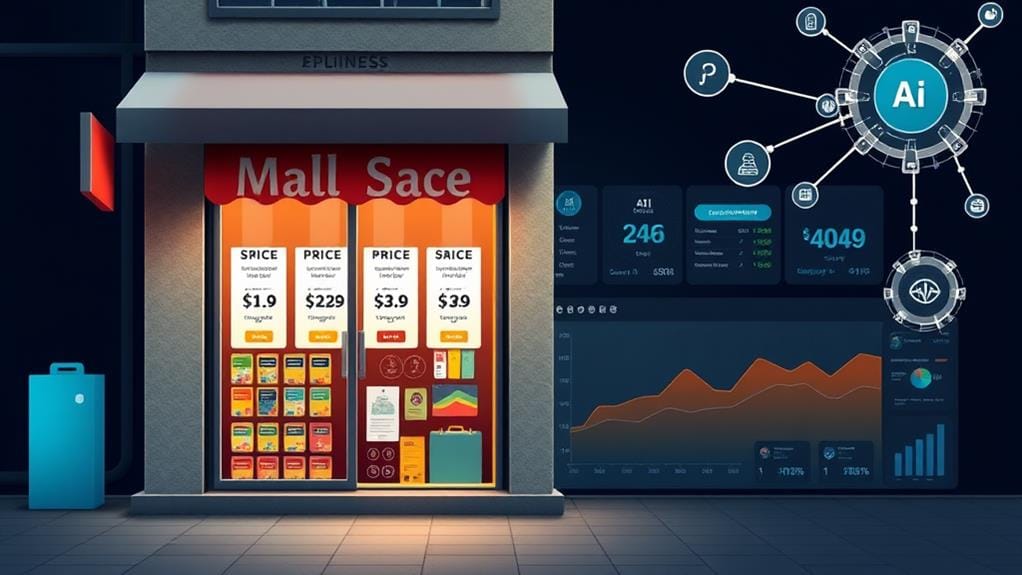
The evolution of customer interactions through technologies like chatbots has paved the way for innovative approaches in pricing strategies, particularly dynamic pricing. This flexible pricing model leverages AI-driven pricing algorithms to adjust prices in real-time, enhancing both customer experience and revenue management for small and medium-sized businesses (SMBs).
By understanding consumer elasticity and market trends, SMBs can strategically implement dynamic pricing that resonates with their customers' value perception.
Integrating dynamic pricing into your business strategy allows for improved sales performance and can bolster customer loyalty.
Effective dynamic pricing hinges upon several key components:
- Pricing psychology: Understanding how consumers perceive prices helps set ideal pricing points.
- Competitive analysis: Regularly monitoring competitors enables businesses to adapt pricing based on market fluctuations.
- Market trends: Keeping abreast of industry changes guarantees your pricing strategy remains relevant and appealing.
- Data-driven adjustments: Utilizing real-time data allows for swift reactions to changes in demand and competition.
- Customer insights: Tailoring prices based on customer preferences enhances personalization and loyalty.
Predictive Customer Insights
Predictive customer insights harness the power of data to inform strategic decision-making for SMBs, enabling them to anticipate consumer behavior with greater accuracy.
By analyzing patterns and trends, businesses can develop tailored marketing strategies that resonate with individual preferences, thereby enhancing customer engagement.
This proactive approach not only improves sales outcomes but also strengthens customer loyalty in an increasingly competitive landscape.
Data-Driven Decision Making
Leveraging data-driven decision-making strategies is essential for small and medium-sized businesses (SMBs) seeking to enhance customer personalization. By harnessing predictive customer insights, SMBs can more effectively tailor their offerings and improve user experience.
However, this journey is not without challenges. Businesses must navigate the complexities of data governance and ethical considerations while ensuring data privacy.
Key strategies for effective data-driven decision-making include:
- Real-time analytics: Leveraging data as it comes in to quickly adapt to customer preferences.
- Integration challenges: Overcoming obstacles in merging various data platforms to create a unified view.
- Technology adoption: Embracing new tools that facilitate better data usage and analysis.
- Measurement metrics: Establishing KPIs that gauge the effectiveness of personalization efforts.
- Industry benchmarks: Utilizing external standards to evaluate performance and identify areas for improvement.
Tailored Marketing Strategies
Harnessing predictive customer insights serves as a powerful catalyst for developing tailored marketing strategies that resonate with individual consumer preferences. Through a nuanced understanding of the customer journey, businesses can craft content personalization strategies that enhance brand loyalty and foster emotional connections.
By leveraging data analytics, SMBs can identify key touchpoints across various platforms, optimizing the user experience and facilitating meaningful audience engagement.
Multi-channel marketing approaches become strategically enhanced when driven by predictive insights, as they allow businesses to target specific customer segments with customized messaging. Social media targeting, for instance, can be refined to guarantee that campaigns align with users' specific interests and behaviors, contributing to stronger retention strategies.
Moreover, integrating customer feedback into this process not only enriches the understanding of consumer needs but also empowers SMBs to adapt their marketing efforts accordingly. By continuously refining strategies based on real-time insights, companies can remain agile and responsive to changing preferences.
Ultimately, the deployment of tailored marketing strategies, informed by predictive analyses, not only elevates the customer experience but considerably boosts the potential for sustained business growth and loyalty.
Recommendations and Upselling
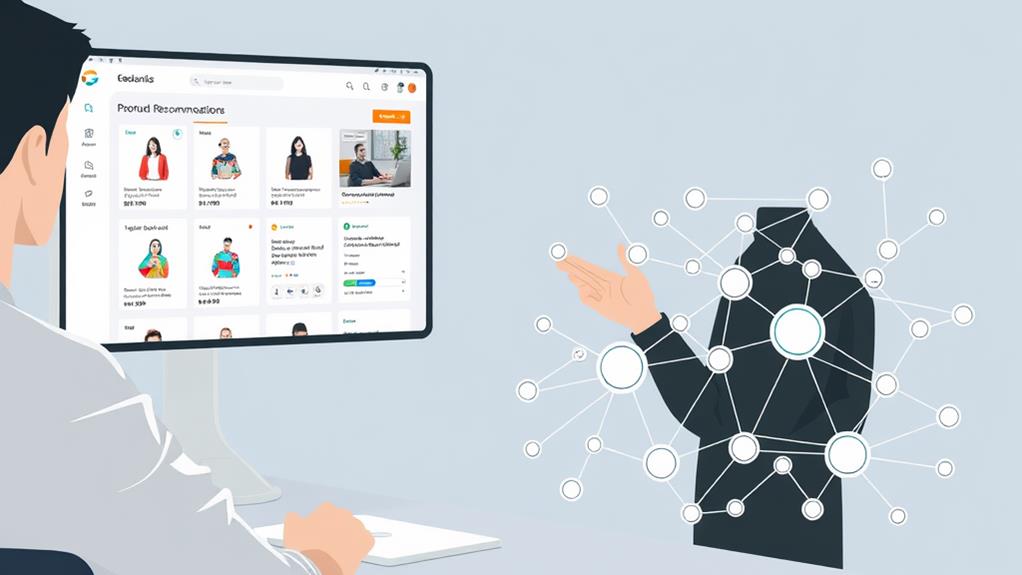
In today's competitive landscape, small and medium-sized businesses (SMBs) can greatly enhance their customer engagement through sophisticated recommendations and upselling strategies powered by AI.
By leveraging machine learning algorithms, SMBs can analyze customer data to provide tailored suggestions that resonate with individual preferences and behaviors. This strategic approach not only fosters loyalty but also can markedly boost revenue.
AI-driven recommendations enable businesses to implement effective cross selling techniques, enriching the customer journey by anticipating needs and enhancing the buying experience.
Consider the following strategies for maximizing the potential of recommendations and upselling:
- Personalized Emails: Send targeted offers based on past purchases or browsing behavior to stimulate interest.
- Dynamic Website Content: Use AI to modify product recommendations in real-time, reflecting user preferences as they navigate your site.
- Intelligent Chatbots: Deploy chatbots that suggest complementary products during customer interactions, making upselling seamless.
- Customer Segmentation: Analyze demographics and purchase history to curate specific bundles that appeal to distinct customer segments.
- Feedback Loop: Regularly gather customer feedback to refine recommendation algorithms and guarantee continuous improvement.
Automating Customer Engagement
Effective customer engagement is essential for the growth of small and medium-sized businesses (SMBs), and automation plays a significant role in achieving this goal. By employing sophisticated engagement tools, SMBs can enhance their customer journey, ensuring a seamless and satisfying experience. Automated responses serve as a cornerstone of service automation, allowing businesses to interact with customers in real-time while optimizing interaction frequency.
Through the strategic application of communication strategies powered by AI, SMBs can maintain consistent engagement that feels personalized, regardless of scale. Automation enables businesses to capture engagement metrics that reveal customer preferences and behaviors, allowing them to refine their interactions and improve user experience. As a result, effective response optimization becomes feasible, ensuring that customers receive timely and relevant information.
Moreover, feedback loops integrated within automated systems allow businesses to continuously learn from their customers. By monitoring the effectiveness of different engagement methods, SMBs can adapt their approaches in real-time, nurturing relationships that drive loyalty and satisfaction.
This constant evolution is not only essential for personalizing experiences but also enhances operational efficiency by reducing the manual workload on staff.
Enhancing Customer Feedback

Customer feedback serves as an essential component in refining and personalizing the SMB customer experience. With the integration of artificial intelligence, businesses can harness customer sentiment analysis to better understand their patrons' perspectives and emotions. This enables small and medium-sized businesses to create robust feedback loops that lead to actionable insights and strategic enhancements.
Here are some key ways AI enhances customer feedback:
- Real-time sentiment analysis: Utilizing AI tools to gauge emotional responses immediately after interactions allows for timely corrections in service or product offerings.
- Predictive analytics: AI can forecast customer trends and preferences, enabling businesses to proactively address potential dissatisfactions.
- Automated surveys: AI streamlines the survey process by creating tailored questionnaires that adapt based on previous responses, ensuring high engagement and relevance.
- Trend identification: By analyzing large volumes of feedback data, AI can uncover patterns and trends in customer behavior that might otherwise go unnoticed.
- Personalized follow-ups: AI can automate customized follow-up communications based on specific feedback, making customers feel valued and heard.
Case Studies of Success
While many small and medium-sized businesses may face challenges in optimizing customer personalization, numerous case studies demonstrate that the integration of AI not only transforms their approach to customer engagement but also greatly enhances overall satisfaction and loyalty.
One significant example is a regional e-commerce retailer that utilized AI-driven tools for customer journey mapping. By analyzing shopper data, they pinpointed key touchpoints and tailored personalized experiences based on individual preferences. The result? A staggering 30% increase in conversion rates and a 25% rise in repeat customers.
Similarly, a boutique hotel leveraged AI to streamline its customer interactions, employing predictive analytics to understand guests' needs before they even stepped foot on the property. Through the deployment of personalized offers and specialized services, the hotel experienced an impressive boost in positive reviews, ultimately leading to higher occupancy rates and a 40% increase in revenues.
These case studies underscore that AI's strength lies not just in automation but in its ability to enhance the nuanced art of personalization. By embracing technology, SMBs can create smoother customer journeys, providing experiences that resonate with unique desires and preferences.
Each successful implementation reinforces the notion that the future of customer engagement is rooted in personalization—where every interaction is tailored, and every customer feels valued. As SMBs continue to explore AI's potential, the blueprint for success is clear: harness technology to transcend traditional methods and forge lasting connections with customers.
Frequently Asked Questions
What Industries Benefit Most From Ai-Driven Customer Personalization?
Various industries reap substantial benefits from AI-driven customer personalization. Retail analytics empowers retailers to craft tailored shopping experiences, while e-commerce strategies leverage data to enhance online buying journeys.
The hospitality sector utilizes AI for refined guest experiences, and healthcare services optimize patient interactions based on individual needs.
Additionally, financial insights generated through AI help firms offer personalized products, while travel personalization guarantees unique itineraries, creating memorable journeys for travelers seeking unique adventures.
How Does AI Respect Customer Privacy During Personalization?
In a recent survey, 79% of consumers expressed concerns about data protection regarding their personal information.
AI respects customer privacy through compliance with privacy regulations and ethical considerations, ensuring that data is collected transparently and securely.
By prioritizing consumer trust, AI-driven systems can utilize anonymized data for personalization, thereby providing tailored experiences while safeguarding individual privacy.
This balanced approach fosters stronger relationships between businesses and their customers, enhancing brand loyalty.
Can Small Businesses Afford AI Tools for Personalization?
Many small businesses may question the affordability of AI tools for personalization.
To address this, effective AI budgeting coupled with a thorough cost-benefit analysis can illuminate the potential value these technologies offer.
By strategically evaluating expenses against the anticipated improvements in customer engagement and retention, small businesses can determine if AI investments align with their goals.
Ultimately, these tools can foster growth while maintaining financial flexibility, empowering businesses to thrive in competitive markets.
What Skills Are Needed to Implement AI in Smbs?
Implementing AI in small and medium-sized businesses (SMBs) requires a robust skill set. Key competencies include data analysis to interpret consumer insights, enabling informed decision-making.
Moreover, familiarity with machine learning algorithms is vital, as these tools can greatly enhance operational efficiency and customer engagement.
In addition, a strategic mindset is essential for integrating AI solutions effectively, empowering businesses to leverage technology while maintaining the flexibility to adapt to evolving market needs.
How Quickly Can SMBS See Results From AI Personalization Efforts?
As the adage goes, "The early bird catches the worm."
Similarly, small and medium-sized businesses (SMBs) can achieve quick wins through AI personalization efforts, often witnessing measurable impact within weeks to months.
By strategically implementing targeted campaigns and personalized content, SMBs can foster customer loyalty and drive engagement faster than traditional methods.
This not only enhances operational efficiency but also empowers business owners to gain a competitive edge, paving the way for sustainable growth.
Conclusion
The integration of AI in enhancing customer personalization for small and medium-sized businesses (SMBs) demonstrates significant potential, with studies indicating that 80% of consumers are more likely to make a purchase when offered a personalized experience. By employing data analytics, personalized marketing campaigns, and advanced customer support solutions such as chatbots, SMBs can foster deeper connections with their clientele. Ultimately, leveraging AI not only drives customer satisfaction but also strengthens brand loyalty, providing a competitive edge in an increasingly saturated market.