The Role of AI in SMB Business Intelligence
AI plays an essential role in enhancing business intelligence for small and medium-sized businesses (SMBs) by improving operational decision-making and customer engagement. Through advanced data analytics and predictive modeling, AI enables accurate market trend forecasting and deep customer segmentation. This leads to optimized resource allocation, cost reductions, and increased productivity. Additionally, AI-driven insights facilitate real-time performance tracking, driving continuous improvement. Challenges such as data quality and integration must be addressed for successful implementation. Overall, the adoption of AI not only enhances operational efficiency but also positions SMBs for sustainable growth in a competitive landscape. Further insights on these dynamics await.
Key Takeaways
- AI enhances operational decision-making in SMBs through advanced data analytics and predictive modeling for better market understanding and customer behavior forecasting.
- Businesses benefit from AI-driven insights that enable improved customer segmentation, tailored offerings, and proactive strategies for competitive advantages.
- Common AI applications include predictive analytics, automation tools, and data visualization technologies that streamline operations and provide valuable customer insights.
- Challenges of AI implementation involve high-quality data management, integration with existing systems, skill gaps, and ethical considerations in data handling.
- Successful AI adoption leads to measurable outcomes, such as reduced costs, increased productivity, and enhanced decision-making capabilities, fostering sustainable growth.
Overview of AI in SMBs

The integration of artificial intelligence (AI) into small and medium-sized businesses (SMBs) is revolutionizing how these organizations harness data for operational decision-making. This transformation is driven by advanced data analytics capabilities that facilitate insightful market analysis, refine customer personalization, and enhance operational efficiency.
SMBs limited by traditional decision-making strategies are finding new opportunities to leverage AI for substantial performance improvements.
AI integration allows for sophisticated predictive modeling, enabling SMBs to forecast market trends and customer behavior with greater accuracy. By analyzing historical data and recognizing patterns, businesses can identify potential revenue streams and mitigate risks, fostering proactive decision-making support.
Additionally, through resource optimization, AI helps SMBs align their operations with evolving market demands, ultimately reducing costs while increasing productivity.
The introduction of AI technologies empowers SMBs to personalize their customer interactions, tailoring marketing strategies and product offerings to individual needs. This level of customization not only enhances customer satisfaction but also drives loyalty, leading to sustainable growth.
As AI tools become increasingly accessible, SMBs are better positioned to compete with larger enterprises, democratizing data-driven insights.
Benefits of AI-Driven Insights
AI-driven insights offer numerous advantages for SMBs, fundamentally reshaping how they approach data analysis and strategy formulation. Leveraging advanced technologies, businesses can glean powerful insights that enhance decision-making and operational efficiency.
These insights allow small and medium-sized businesses to shift from reactive to proactive strategies, granting them a significant competitive advantage in their industries.
The following benefits illustrate the transformative impact of AI-driven insights:
- Predictive Modeling: AI enables SMBs to anticipate future trends through sophisticated predictive modeling, allowing companies to prepare for market changes and consumer behavior shifts effectively.
- Customer Segmentation: AI tools facilitate accurate customer segmentation, enabling businesses to tailor their products and marketing efforts to specific demographics, thereby enhancing customer engagement and satisfaction.
- Performance Metrics and Trend Identification: Through real-time performance metrics, SMBs can identify key trends in their operations, fostering a culture of continuous improvement and informed decision support.
Common AI Applications in SMBs
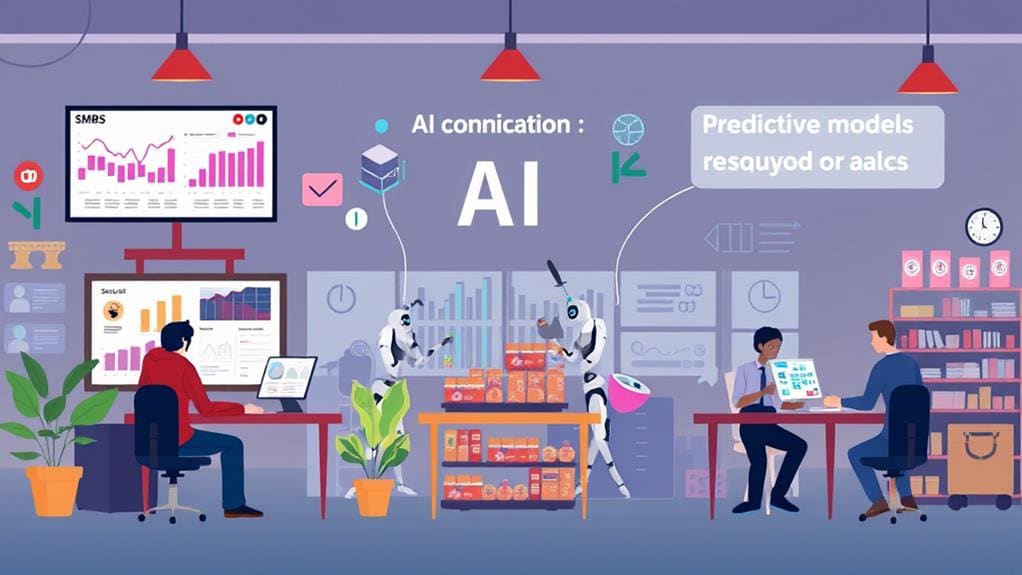
Exploring the various applications of artificial intelligence reveals a spectrum of opportunities that small and medium-sized businesses (SMBs) can harness to enhance their operations and customer interactions.
For instance, AI-driven analytics tools provide valuable customer insights, enabling SMBs to tailor their offerings to meet specific consumer needs. By leveraging predictive analytics, businesses can identify trends and behavior patterns, allowing for more accurate sales forecasting that can inform inventory and financial decisions.
Automation tools are another critical application, greatly improving operational efficiency by streamlining repetitive tasks such as data entry and customer communication. This automation not only reduces human error but also frees up valuable human resources for more strategic initiatives.
Additionally, advanced data visualization technologies help SMBs interpret large datasets, transforming complex analytics into comprehensible visual formats. This serves as a powerful decision support mechanism, empowering stakeholders to make data-driven choices swiftly.
Furthermore, AI plays a pivotal role in marketing optimization, as it can assess campaign effectiveness and customer engagement metrics, leading to intelligent reallocations of budget and resources. By continuously refining marketing strategies based on actionable insights, SMBs can increase return on investment and improve overall brand positioning.
Challenges of Implementing AI
Implementing artificial intelligence within small and medium-sized businesses (SMBs) presents significant challenges that can hinder the potential benefits of these technologies. These hurdles can prevent the holistic utilization of AI, thereby affecting decision-making, operational efficiency, and overall growth.
- Data Quality: For AI algorithms to function effectively, they require high-quality data. In many SMBs, inadequate data management practices lead to inconsistent and unreliable datasets, impacting AI performance.
- Integration Hurdles: Merging AI systems with existing infrastructure often presents technical challenges. Organizations may face compatibility issues, resulting in delays and increased costs.
- Skill Gaps: The implementation of AI necessitates a workforce equipped with specialized skills. Many SMBs struggle to find employees with the technical expertise to manage and analyze AI-driven insights effectively.
Other significant obstacles include cost barriers that can prevent investment in AI solutions, resistance to change from employees who may fear job displacement, and scalability issues, which arise when systems cannot grow to meet increasing demands.
Additionally, ethical considerations in data handling and vendor selection can complicate the decision-making process, further deterring adoption.
Recognizing these challenges is essential for SMBs to devise effective strategies that align AI implementation with their long-term business objectives. By addressing these issues proactively, businesses can release the transformative potential of AI, leading to informed decisions and enhanced operational capabilities.
Future Trends in AI for SMBs

Increasingly, small and medium-sized businesses (SMBs) are recognizing the potential of artificial intelligence to enhance their operational capabilities and drive strategic growth. As we look toward the future, several key trends in AI are set to reshape how SMBs leverage business intelligence.
One significant trend is the increased adoption of predictive analytics, enabling SMBs to forecast market trends and customer behaviors with greater accuracy. By harnessing these insights, businesses can optimize their operations and adapt more swiftly to changing demands.
Data visualization tools combined with natural language processing (NLP) will also empower SMBs to translate complex datasets into actionable insights. This fusion will allow non-technical stakeholders to derive meaning from analytics, fostering a data-driven culture across organizations.
As customer segmentation becomes more nuanced, these tools will facilitate targeted marketing strategies that align with individual consumer preferences, promoting personalized marketing efforts.
Furthermore, automated reporting capabilities are set to enhance operational efficiency, liberating employees from tedious data compilation tasks. Real-time anomaly detection systems will alert businesses to discrepancies, ensuring that they can quickly address potential issues before they escalate.
These innovations will not only bolster decision-making processes but will also lead to significant cost savings.
Case Studies of Successful Adoption
Examining successful case studies of AI adoption in small and medium-sized businesses (SMBs) reveals key implementation strategies that contribute to transformative outcomes.
By analyzing specific examples, we can identify measurable benefits, such as increased operational efficiencies and enhanced decision-making capabilities.
These real-world insights offer valuable lessons for SMBs looking to leverage AI technology effectively.
Success Stories Overview
Numerous small and medium-sized businesses (SMBs) have successfully integrated AI-driven business intelligence solutions, resulting in transformative impacts on their operations and decision-making processes.
These organizations illustrate the powerful potential of AI adoption in driving data-driven decisions and achieving operational efficiency.
- Retail SMB: Through enhanced analytics and predictive modeling, a retail company gained customer insights that enabled them to optimize inventory management, resulting in a 30% reduction of excess stock and improved sales forecasting accuracy.
- Manufacturing Firm: By implementing AI solutions for performance tracking and trend analysis, a manufacturing firm realized a 25% increase in production efficiency. This allowed them to maintain a competitive advantage in a crowded market.
- Healthcare Provider: A healthcare SMB utilized AI to enhance customer insights, streamlining appointment scheduling and resource optimization, which decreased patient wait times by 40%, greatly improving service delivery.
These case studies illustrate how SMBs leveraging AI with a focus on strategic implementation can enhance their business intelligence capabilities.
The outcome? Not just survival, but a robust platform for future growth and freedom in maneuvering market uncertainties.
Key Implementation Strategies
The successful integration of AI-driven business intelligence in various SMBs reveals distinct strategies that can be adopted to replicate such outcomes.
First and foremost, effective data integration is fundamental; businesses must guarantee that their existing systems communicate seamlessly with new AI tools. This step lays the foundation for accurate analytics and insights.
Next, tool selection is critical. SMBs should evaluate platforms based on scalability, guaranteeing they can adapt as business needs evolve. Performance metrics must be defined early on to measure the system's impact accurately.
User training cannot be overlooked; employees equipped with the right skills can maximize the value of AI technologies. Extensive training sessions bolster user confidence and performance while aiding in change management.
Moreover, thoughtful cost management is paramount, particularly for SMBs operating within tight budgets. Implementing a phased rollout can mitigate financial strain while enhancing stakeholder engagement through transparent communication about progress and challenges.
Measurable Outcomes Achieved
Measurable success serves as proof of the effective adoption of AI-driven business intelligence in small and medium-sized businesses (SMBs). Case studies illustrate how these technologies yield quantifiable benefits that enhance decision support and operational efficiency. Significant outcomes observed include:
- Cost Reduction: AI systems improve data accuracy, allowing SMBs to identify and eliminate unnecessary expenditures, thereby directly impacting the bottom line.
- Enhanced Performance Metrics: Predictive analysis tools empower businesses to track performance metrics with greater precision, facilitating timely adjustments and leading to overall productivity gains.
- Valuable Customer Insights: By leveraging AI, businesses gain deep insights into customer behavior, enabling personalized marketing approaches that create a distinct competitive advantage.
These measurable outcomes underscore the transformative potential of AI in optimizing business operations. The integration of advanced analytics and continued reliance on data fosters an environment where actionable intelligence informs strategies.
Ultimately, adopting AI-driven solutions not only promotes growth but also liberates SMBs from reliance on outdated methodologies, paving the way for innovation and sustained success. As a result, businesses can invest resources more wisely, ensuring that they remain agile and responsive in a dynamic market.
Frequently Asked Questions
What Types of AI Tools Are Best for Smbs?
Small and medium-sized businesses (SMBs) can greatly benefit from AI tools such as predictive analytics, which forecasts trends and behaviors.
Natural language processing can enhance customer interactions by analyzing feedback and improving communication.
Additionally, robust customer segmentation tools allow for targeted marketing strategies, ensuring resources are used efficiently.
Moreover, decision support systems maximize operational effectiveness, enabling informed choices through data-driven insights, ultimately empowering SMBs to thrive in a competitive market.
How Can SMBS Begin Their AI Journey?
Starting on the AI journey for small and medium businesses (SMBs) can feel as monumental as launching a space mission.
To initiate this process, SMBs should first conduct an AI readiness assessment, identifying current capabilities and gaps.
Following this, investing in data literacy training for employees is crucial, ensuring they understand how to leverage data effectively.
These foundational steps can empower SMBs to harness AI's potential for strategic growth and enhanced decision-making.
Are There Specific Industries Benefiting More From AI in Smbs?
Various industries exhibit pronounced benefits from AI applications within small to medium-sized businesses (SMBs).
In retail analytics, AI optimizes inventory management and enhances customer targeting.
Healthcare insights derived from AI facilitate improved patient outcomes and operational efficiencies.
Financial forecasting leverages predictive analytics to bolster decision-making in finance-related SMBs, while marketing automation enables precise campaign management and customer engagement.
These advancements empower SMBs to harness data, driving informed strategies and achieving sustained growth.
What Are the Costs Associated With AI Implementation for Smbs?
AI implementation for small and medium-sized businesses (SMBs) incurs several costs requiring extensive cost analysis and budget considerations.
Key expenses include training expenses for staff, maintenance costs for technology infrastructure, and resource allocation for ongoing support.
Additionally, scalability factors must be considered to accommodate future growth.
A detailed ROI assessment is essential to guarantee that the long-term benefits of AI outweigh these initial financial commitments, ultimately driving strategic decision-making for the business.
How Can SMBS Measure the Success of Their AI Initiatives?
Small and medium-sized businesses (SMBs) can effectively measure the success of their AI initiatives by establishing clear success metrics and performance indicators.
These may include improvements in operational efficiency, reductions in costs, enhanced customer satisfaction, and increased revenue growth.
Conclusion
In summary, the integration of artificial intelligence in small and medium-sized businesses (SMBs) acts as a lighthouse, guiding them through the turbulent waters of data-driven decision-making. By harnessing AI-driven insights, SMBs can access enhanced operational efficiency, improved customer engagement, and targeted market strategies. However, steering through the complexities of implementation poses significant challenges. As AI technology continues to evolve, its transformative potential will serve as a catalyst for growth and innovation within the SMB landscape.