How to Implement AI in SMBs to Stay Competitive
To implement AI in small and medium-sized businesses (SMBs), begin by understanding the basics, such as machine learning and predictive analytics. Assess your operational needs to identify inefficiencies ripe for automation. Next, select AI tools that scale with your business and integrate them seamlessly into existing systems. Focus on training your team to fill skill gaps, fostering a culture of continuous learning. Measure success through robust performance metrics and adapt strategies accordingly. This strategic approach not only enhances efficiency but also positions your business competitively in the evolving market, paving the way for deeper insights into successful implementation.
Key Takeaways
- Assess operational inefficiencies to identify areas where AI can optimize processes and resource allocation effectively.
- Select scalable AI tools that align with business needs and ensure a seamless integration with existing systems.
- Invest in training programs to address skill gaps and foster a culture of continuous learning and adaptability among team members.
- Establish clear performance metrics and KPIs to evaluate AI effectiveness and guide future resource allocation.
- Maintain a commitment to ethical AI practices to build consumer trust and ensure responsible technology use.
Understanding AI Basics
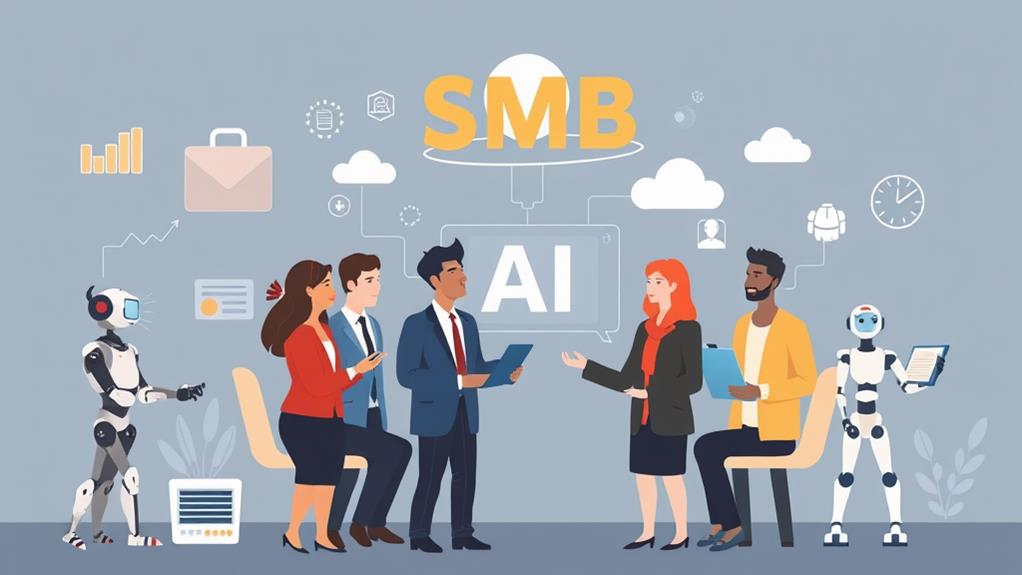
Artificial intelligence (AI) has emerged as a transformative force in the business landscape, reshaping how organizations operate and make decisions. Understanding AI fundamentals is critical for small and medium-sized businesses (SMBs) seeking to harness its power to gain a competitive edge.
At its core, AI encompasses various technologies, including machine learning, which empowers systems to learn from data and improve over time. Machine learning serves as a bridge to more complex structures like neural networks, which mimic human brain functionality to process and analyze vast amounts of data.
These systems can discern patterns, enabling predictive analytics that informs strategic decision-making. Predictive analytics allows SMBs to anticipate market trends and customer needs, demonstrating automation benefits that can streamline operations and enhance efficiency.
Different algorithm types, such as supervised and unsupervised learning, provide tailored solutions to specific business challenges. However, alongside the technical implementation, AI ethics must also be an integral consideration. Responsible AI deployment requires transparent data usage and fairness to prevent bias, ensuring that businesses maintain consumer trust.
Ultimately, the journey into AI requires a strategic vision that balances innovation with ethical integrity. By embracing these AI fundamentals, SMBs can leverage data analysis and machine learning to not only automate tasks but also reinvent their operational frameworks, paving the way for sustainable growth in an increasingly dynamic marketplace.
Identifying Business Needs
A thorough understanding of specific business needs is essential for SMBs aiming to effectively implement AI solutions. To begin this journey, organizations must assess where current operational inefficiencies lie. This includes scrutinizing areas such as resource allocation, where AI can considerably enhance the optimization of both human and financial assets.
Integrating AI into data analysis can empower businesses to draw meaningful insights from customer feedback, which in turn can inform product development and enhance the customer experience. In addition, understanding market trends and competitor insights enables SMBs to position themselves strategically within their respective industries. By leveraging AI tools, companies can not only react to these insights with agility but also anticipate future market dynamics.
Additionally, process automation remains a critical area for SMBs seeking operational efficiency. Implementing AI-driven automation can streamline repetitive tasks, thereby allowing human employees to focus on higher-value activities such as strategic decision making and innovation.
Identifying specific processes ripe for automation is essential; tasks such as invoicing, reporting, and customer queries often represent low-hanging fruit for AI integration.
Selecting AI Tools

Selecting the right AI tools is essential for SMBs aiming to enhance their operational capabilities and drive innovation. As SMBs navigate the competitive landscape, understanding the various AI tool types—such as machine learning platforms, natural language processing solutions, and robotic process automation—is necessary. This knowledge allows for informed decision-making based on specific business needs.
Cost considerations play an important role in selection. SMBs must evaluate not only the initial investment but also ongoing expenses, including maintenance and upgrades.
Scalability factors are equally important, as organizations should opt for solutions that can grow with their business demands, avoiding the pitfalls of premature obsolescence.
User experience should not be overlooked; intuitive interfaces can greatly improve employee adoption rates and drive productivity. Furthermore, fostering strategic vendor partnerships can amplify the benefits of AI tool implementation, providing support and expertise throughout the process.
Beyond simple selection, implementation timelines must be meticulously planned to guarantee smooth integration with existing systems.
Alignment of performance metrics with organizational goals is essential for evaluating the effectiveness of selected AI tools. SMBs should remain attuned to industry trends to identify emerging AI technologies that could offer competitive advantages.
Integrating AI Solutions
Successfully implementing AI solutions requires a structured approach that begins with a well-defined strategy. This strategic framework should prioritize AI collaboration strategies that align with business objectives and enhance operational effectiveness.
As AI continues to evolve, staying informed about AI market trends becomes essential for making timely decisions that are ahead of the competition.
Central to effective integration is the cultivation of AI vendor partnerships, which can provide not only cutting-edge technology, but also insights into best practices and software scalability options.
SMBs must also consider the AI cost implications associated with these partnerships, ensuring that investments yield sustainable returns.
While financial feasibility is important, AI ethical considerations must not be overlooked. Developing solutions that respect user privacy and promote responsible AI use safeguards a company's reputation and fosters trust with customers.
An ethical approach positions the organization as a leading advocate in the rapidly changing AI landscape, appealing to socially conscious consumers.
Enhancing the AI user experience is another critical area that demands attention. Solutions must be intuitive and user-friendly, enabling employees to navigate new systems seamlessly, thereby maximizing productivity.
Training Your Team

To successfully harness AI capabilities, it is essential for SMBs to identify skill gaps within their teams that may hinder effective implementation.
Fostering a culture of continuous learning will empower employees to adapt and grow, ensuring they remain at the forefront of technological advancements.
This strategic focus not only enhances individual competencies but also strengthens the organization's overall competitive edge in an increasingly AI-driven marketplace.
Identifying Skill Gaps
Identifying skill gaps within your team is a critical step toward effective AI implementation in small to medium-sized businesses (SMBs). To harness the transformative potential of AI, a robust skill assessment process is vital.
Begin by conducting a workforce analysis to pinpoint the competencies that your team currently possesses and juxtapose them against the skills required for AI integration. This exercise should encompass both technical skills, such as data analysis and machine learning proficiency, and soft skills, like problem-solving and adaptability.
Clarity in your vision helps to define the specific roles where these gaps exist and the level of expertise required to bridge them. Using the insights gathered from this analysis, you can create tailored professional development plans that empower your team members to acquire the necessary skills.
This strategic focus not only enhances your workforce's capabilities but also cultivates an environment of innovation where employees feel liberated to explore and engage with artificial intelligence.
Ultimately, addressing skill gaps is not just about immediate needs; it paves the way for sustained growth and competitiveness in a rapidly evolving digital landscape. Investing in skill development will guarantee your SMB thrives in the age of AI.
Continuous Learning Culture
Establishing a continuous learning culture is imperative for SMBs seeking to adapt and thrive in an AI-driven landscape. By fostering employee engagement through structured learning opportunities, companies can encourage knowledge sharing and create a collaborative environment that drives innovation.
Implementing mentorship programs enables experienced team members to guide newcomers, cultivating a strong foundation for peer learning. Feedback loops are essential in this process, as they allow employees to reflect on their learning experiences and adjust their approaches accordingly.
Incorporating innovation workshops further stimulates creativity, allowing teams to brainstorm solutions that leverage AI effectively. To cultivate a learning culture, SMBs must prioritize resource allocation strategically, ensuring that training and development initiatives are both accessible and impactful.
Adaptability strategies should be embedded in the organizational framework, reinforcing the importance of continuous skill enhancement in the face of evolving technologies. Ultimately, by championing a culture of continuous learning, SMBs can not only enhance their workforce's capabilities but also position themselves as agile and forward-thinking organizations in a competitive marketplace.
This proactive approach to employee development fosters resilience and readiness for future challenges, ensuring sustained growth and success.
Measuring Success
Effectively measuring success in AI implementation is fundamental for SMBs to guarantee that their investments yield tangible benefits. Establishing robust performance metrics is the foundation for evaluating AI effectiveness. Implementing key performance indicators (KPIs) allows businesses to track specific outcomes related to customer engagement, operational efficiency, and revenue growth.
Conducting thorough ROI analysis is essential to understanding the financial impact of AI initiatives. By quantifying gains and evaluating costs, SMBs can make informed decisions regarding resource allocation. Growth tracking through continuous monitoring guarantees the alignment of AI objectives with business goals, facilitating proactive adjustments in strategy and execution.
Gathering and analyzing customer feedback is significant for refining AI applications. It provides insights into user experience and satisfaction, further informing data-driven decisions. Additionally, benchmarking success against industry standards or case studies from similar SMBs can offer valuable perspectives on AI performance and areas for improvement.
To remain competitive, SMBs must recognize that measurement is not a one-time event but a continuous process. Establishing a flexible framework for ongoing evaluation and adaptation will empower organizations to innovate and respond swiftly to changing market dynamics.
Ultimately, a strategic focus on measuring success will not only validate AI investments but also lay the groundwork for future growth, positioning SMBs as leaders in their respective fields. By embracing a culture of accountability and transparency in measuring outcomes, SMBs can release the full potential of AI technology, driving sustainable success.
Frequently Asked Questions
How Much Budget Is Needed for AI Implementation in Smbs?
Determining the budget required for AI implementation in small and medium-sized businesses necessitates thorough cost estimation and strategic budget allocation.
Costs can vary widely based on factors such as technology selection, required infrastructure, and training needs. A strategic vision should prioritize innovation while ensuring that resources are allocated efficiently.
Companies should anticipate both initial investments and ongoing maintenance costs to encompass a complete approach, enabling them to harness AI's transformative potential effectively.
What Industries Benefit Most From AI Adoption?
Industries that benefit most from AI adoption include healthcare, with enhancements in patient care; retail, through personalization of customer experiences; manufacturing, via automation of processes; and finance, improving forecasting accuracy.
Additionally, marketing optimization enhances strategic outreach, while AI strengthens customer service through intelligent support systems.
Logistics efficiency is improved through advanced supply chain management, and cybersecurity improvements protect organizations against growing threats.
These advancements collectively drive innovation and operational freedom across sectors.
How Can I Ensure Data Privacy With AI Solutions?
To guarantee data privacy with AI solutions, organizations must prioritize data encryption and secure storage to protect sensitive information from unauthorized access.
Obtaining user consent is essential, alongside adherence to compliance regulations, such as GDPR.
Conducting regular risk assessments will identify vulnerabilities, while implementing extensive employee training can foster a culture of privacy awareness.
What Are the Common Pitfalls in AI Implementation?
Notably, many organizations set out to harness AI yet stumble over the most basic hurdles.
Common pitfalls include overlooking data quality and neglecting thorough staff training, which are vital for successful integration.
Additionally, change management can be intimidating, alongside technology selection that often leads to scalability issues.
Reliance on vendor reliability can further complicate efforts, while insufficient focus on user adoption renders innovative solutions futile.
Addressing these challenges is essential for achieving long-term success.
How Quickly Can I Expect ROI From AI Investments?
The AI investment timeline can vary considerably, typically ranging from six months to several years, depending on project complexity and organization size.
To guarantee that you accurately assess ROI, it's essential to establish clear metrics for measuring AI success from the outset.
Adopting a phased implementation approach can accelerate outcomes, fostering innovation while enabling continual evaluation and adjustment, ultimately leading to improved efficiency and competitive advantage in the business landscape.
Conclusion
The implementation of artificial intelligence within small and medium-sized businesses (SMBs) is not merely advantageous; it has become essential for maintaining competitive relevance. By leveraging AI technologies strategically aligned with identified business needs, companies can achieve operational efficiencies, enhanced customer experiences, and data-driven decision-making. Continuous evaluation of AI integration and its impact on performance metrics will guarantee sustained innovative growth. Consequently, SMBs that embrace AI are poised to thrive in an increasingly technology-driven marketplace.